Saudi Arabia begins Hajj 2027 preparations with 75 countries
The Saudi Ministry of Hajj and Umrah has opened Hajj 2027 preparations with meetings involving Hajj affairs offices from...
Definition, virtues, rulings, obligations, and everything you need to know before you begin
The Arabic word "Hajj" (حَجّ) linguistically means to intend or to set out towards a place. It carries the meaning of deliberately directing oneself to a destination of significance and honour. Some scholars of Arabic also note that it conveys the meaning of repeated visitation, which is why the one who performs Hajj is called a Hajji - a person who has made a purposeful, sacred journey.
In the Shariah (Islamic law), Hajj is defined as: the act of worship consisting of visiting the Sacred House of Allah (al-Masjid al-Haram) in Makkah al-Mukarramah, and performing specific rites at specific places during specific days in the month of Dhul Hijjah. These rites include entering the state of Ihram, standing at Arafah, performing Tawaf around the Ka'bah, walking between Safa and Marwah, pelting the Jamarat, and other acts of devotion, all following the manner prescribed by the Prophet Muhammad (peace and blessings be upon him).
Imam al-Nawawi (may Allah have mercy on him) defined it in al-Majmu' as: "A specific act of worship performed at a specific time in a specific place."
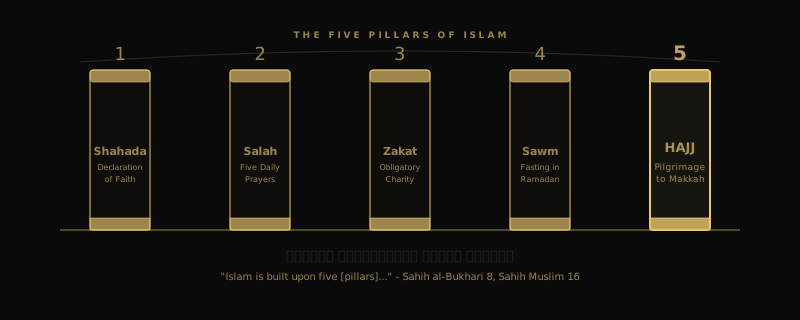
Hajj is the fifth pillar of Islam - the final of the five foundational acts upon which the entire religion is built. It is the culmination of a Muslim's obligations, the grand act that combines physical exertion, financial expenditure, spiritual devotion, and complete submission to Allah.
"Islam is built upon five: testifying that there is no god but Allah and that Muhammad is the Messenger of Allah, establishing the prayer, giving Zakah, performing Hajj to the House, and fasting the month of Ramadan."
Sahih al-Bukhari 8, Sahih Muslim 16 - Narrated by Ibn Umar (may Allah be pleased with him)Allah, the Most High, commands in the Quran:
وَلِلَّهِ عَلَى النَّاسِ حِجُّ الْبَيْتِ مَنِ اسْتَطَاعَ إِلَيْهِ سَبِيلًا ۚ وَمَن كَفَرَ فَإِنَّ اللَّهَ غَنِيٌّ عَنِ الْعَالَمِينَ
"And [due] to Allah from the people is a pilgrimage to the House - for whoever is able to find thereto a way. But whoever disbelieves - then indeed, Allah is free from need of the worlds."
Surah Aal-Imran, 3:97
Ibn Kathir (may Allah have mercy on him) commented on this verse in his renowned Tafsir: "This verse establishes the obligation of Hajj. The words 'whoever is able to find thereto a way' indicate that Hajj is only obligatory upon those who have the means - physical, financial, and in terms of safety." He further noted that the ending of the verse - "whoever disbelieves" - shows the severity of abandoning Hajj when one has the means, as Allah likened it to disbelief.
The scholars differ on the exact year Hajj was made obligatory:
Regardless of the exact year, the Prophet (peace and blessings be upon him) himself only performed Hajj once - in 10 AH, during what is known as the Farewell Pilgrimage (Hajjat al-Wada'). This Hajj became the model and the Sunnah that all subsequent generations have followed.
Key Point: The Prophet (peace and blessings be upon him) performed Hajj only once in his life. He performed Umrah four times. Despite the immense virtue of Hajj, Allah's wisdom is that it is obligatory only once - a mercy upon this Ummah.
Hajj is the only pillar of Islam that requires you to leave everything behind - your home, your comfort, your daily routine, your social identity. When you don the two white sheets of Ihram, you shed the markers of wealth, status, and worldly distinction. The CEO and the street sweeper stand shoulder to shoulder, identical in appearance, calling upon the same Lord with the same words.
Hajj is a rehearsal for the Day of Judgement. On that Day, all of humanity will stand equal before Allah - barefoot, uncovered, with nothing but their deeds. The plains of Arafah, where millions stand in supplication under the open sky, offer us a taste of that final gathering. The one who truly understands this will never be the same again.
The virtues of Hajj are immense and are mentioned extensively in the Quran and the Sunnah of the Prophet (peace and blessings be upon him). No serious pilgrim should embark on this journey without deeply internalising these blessings, for it is the knowledge of what awaits the sincere pilgrim that fuels patience, endurance, and devotion throughout the rites.
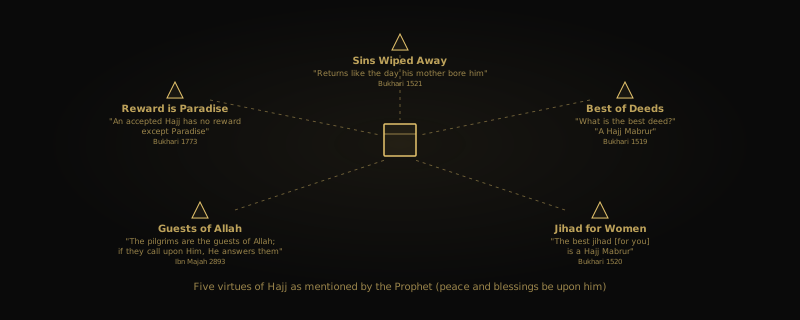
"Whoever performs Hajj and does not commit any obscenity (rafath) or transgression (fusuq) shall return [free of sin] as on the day his mother bore him."
Sahih al-Bukhari 1521, Sahih Muslim 1350 - Narrated by Abu Hurairah (may Allah be pleased with him)Imam al-Nawawi explained that rafath here refers to sexual intercourse and also to obscene, foul, or indecent speech. Fusuq means all acts of disobedience and sin. The pilgrim who guards their tongue, controls their desires, and maintains ihram's sanctity will return home as pure as a newborn.
Ibn Hajar al-Asqalani noted in Fath al-Bari that this hadith is evidence that Hajj expiates all minor sins. As for major sins, the majority of scholars hold that they require specific repentance (tawbah), though some scholars have argued that an accepted Hajj can expiate even major sins based on the general wording of the hadith.
"An Umrah to another Umrah is expiation for whatever [sins] come between them, and an accepted Hajj (Hajj Mabrur) has no reward except Paradise."
Sahih al-Bukhari 1773, Sahih Muslim 1349 - Narrated by Abu Hurairah (may Allah be pleased with him)Al-Hasan al-Basri said about the meaning of Hajj Mabrur: "It means that a person, after performing Hajj, desires the Hereafter rather than the material pleasures of this world." Others have said it means a Hajj performed sincerely for Allah's sake, free from showing off, and in which no sins were committed. The scholars also noted that a sign of an accepted Hajj is that the person's state after Hajj is better than their state before it.
The Prophet (peace and blessings be upon him) was asked: "What is the best deed?" He said: "Belief in Allah and His Messenger." He was asked: "Then what?" He said: "Jihad in the cause of Allah." He was asked: "Then what?" He said: "An accepted Hajj (Hajj Mabrur)."
Sahih al-Bukhari 1519 - Narrated by Abu Hurairah (may Allah be pleased with him)The fact that the Prophet (peace and blessings be upon him) ranked Hajj Mabrur alongside faith and jihad demonstrates its extraordinary status in Islam. It is not merely a ritual, but one of the greatest acts a Muslim can ever perform.
"The pilgrims performing Hajj and Umrah are the guests of Allah. He called them and they responded. They ask Him and He gives them."
Sunan Ibn Majah 2892 - Narrated by Abu Hurairah (may Allah be pleased with him)What an extraordinary honour - to be called a guest of Allah. A guest is treated with generosity, hospitality, and kindness. When the Lord of the Worlds Himself is your Host, what could possibly be withheld from you? This hadith should fill every pilgrim with certainty that their du'as during Hajj will be answered.
Aishah (may Allah be pleased with her) said: "O Messenger of Allah, is there Jihad for women?" He replied: "Yes, a Jihad in which there is no fighting: Hajj and Umrah."
Sunan Ibn Majah 2901 - Narrated by Aishah (may Allah be pleased with her)This hadith shows the immense spiritual rank of Hajj - that for women, it is equivalent in reward to jihad in the path of Allah. It also shows the mercy of Islam in providing women with a path to the highest rewards without requiring them to engage in combat.
"Perform Hajj and Umrah consecutively; for they remove poverty and sin as the bellows removes impurity from iron, gold, and silver."
Sunan al-Tirmidhi 810, Sunan al-Nasai 2631 - Narrated by Abdullah ibn Mas'ud (may Allah be pleased with him)This hadith contains a remarkable simile: just as a blacksmith's bellows purifies metals by burning away impurities, Hajj and Umrah purify the believer's soul from sin and purify their provision from poverty. The scholars of hadith have noted that performing Hajj and Umrah repeatedly is a means of both spiritual and material blessing.
"There are no days on which righteous deeds are more beloved to Allah than these ten days." They said: "Not even jihad in the cause of Allah?" He said: "Not even jihad in the cause of Allah, except for a man who goes out with his self and his wealth and returns with neither."
Sahih al-Bukhari 969 - Narrated by Ibn Abbas (may Allah be pleased with them both)The first ten days of Dhul Hijjah are the most virtuous days of the entire year. It is during these blessed days that the rites of Hajj are performed. Allah swears by these days in the Quran: "By the dawn, and by the ten nights" (Surah al-Fajr, 89:1-2). Ibn Kathir, Ibn Abbas, and other great scholars identified these "ten nights" as the first ten days of Dhul Hijjah.
"There is no day on which Allah frees more people from the Fire than the Day of Arafah. He draws near and then He boasts about them to the angels and says: 'What do these people want?'"
Sahih Muslim 1348 - Narrated by Aishah (may Allah be pleased with her)The standing at Arafah is the pinnacle of Hajj. On this single day, more people are freed from the Hellfire than on any other day of the year. The Prophet (peace and blessings be upon him) also said: "Hajj is Arafah" (Sunan al-Tirmidhi 889, Sunan al-Nasai 3016), indicating that the entire Hajj centres upon this one act of standing before Allah on the plains of Arafah.
Consider the extraordinary generosity of your Lord. He calls you to His House. He pays for your journey through the provision He gave you. He forgives your sins when you arrive. He answers your prayers. He frees you from the Fire. He gives you Paradise as a reward. And then He thanks the angels for your coming. You are the guest, but He is the One who benefits you at every step. This is the nature of your Lord - al-Karim, the Most Generous, whose generosity has no limit and no condition except sincerity.
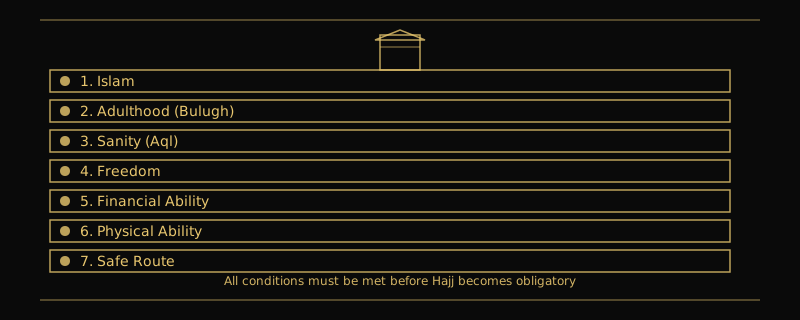
Hajj is not obligatory upon every single Muslim without exception. Allah, in His mercy and justice, has stipulated specific conditions that must be met before Hajj becomes an obligation. The scholars have derived these conditions from the Quran, the Sunnah, and the consensus of the Companions.
Hajj is only obligatory upon a Muslim. A non-Muslim is not addressed with the obligation of Hajj (though they will be held accountable in the Hereafter for not accepting Islam in the first place). If a person accepts Islam, Hajj becomes obligatory upon them if the remaining conditions are met.
Hajj is not obligatory upon a child who has not yet reached puberty. However, if a child performs Hajj, it is valid and they will receive reward for it, but it does not count as their obligatory Hajj. Once they reach adulthood, they must still perform the obligatory Hajj if they are able.
A woman lifted up a child and asked: "O Messenger of Allah, is there Hajj for this one?" He said: "Yes, and you will have a reward."
Sahih Muslim 1336 - Narrated by Ibn Abbas (may Allah be pleased with them both)Hajj is not obligatory upon one who is insane or mentally incapacitated. The Prophet (peace and blessings be upon him) said: "The pen is lifted from three: from the sleeping person until he wakes, from the child until he reaches puberty, and from the insane person until he regains his sanity." (Abu Dawud 4403, authenticated by al-Albani). Since the insane person is not held accountable, they are not obligated to perform Hajj.
Hajj is not obligatory upon one who is enslaved, as they do not have the freedom or the means to undertake the journey. This condition was historically significant. If an enslaved person performed Hajj and was later freed, they would still need to perform Hajj again as their obligatory Hajj.
The pilgrim must have sufficient financial means to cover:
Key Point: "Ability" (istitaa'ah) in the verse "for whoever is able to find thereto a way" (3:97) encompasses financial ability, physical ability, and safety of the route. If any of these is absent, the obligation is lifted.
The pilgrim must be physically capable of performing the journey and the rites. A person who is chronically ill, elderly and frail, or otherwise physically incapable is not required to perform Hajj in person. However, if they have the financial means, they are required to appoint someone to perform Hajj on their behalf (see the section on Hajj on Behalf of Others below).
The route to Makkah must be reasonably safe. If the journey poses a genuine threat to one's life - such as war, banditry, or natural disaster - then the obligation is suspended until the route is safe. The scholars have clarified that ordinary hardships of travel (fatigue, discomfort, homesickness) do not constitute valid excuses.
This is one of the most discussed conditions. The Prophet (peace and blessings be upon him) said:
"No woman should travel except with a mahram." A man stood up and said: "O Messenger of Allah, my wife has set out for Hajj, and I have been enlisted for such-and-such a military expedition." He said: "Go and perform Hajj with your wife."
Sahih al-Bukhari 1862, Sahih Muslim 1341 - Narrated by Ibn Abbas (may Allah be pleased with them both)A mahram is a male relative whom the woman cannot marry: her husband, father, son, brother, uncle, nephew, father-in-law, or son-in-law (whether by blood, marriage, or breastfeeding).
Hanafi and Hanbali: A mahram is strictly required for a woman to travel for Hajj. Without a mahram, Hajj is not obligatory upon her, even if she can afford it. If she dies without having performed Hajj because no mahram was available, she is not sinful.
Shafi'i and Maliki: A mahram is preferred but not an absolute requirement for the obligatory Hajj. If a woman cannot find a mahram, she may travel with a group of trustworthy women or reliable companions. Imam al-Nawawi stated in al-Majmu' that this is the position of the Shafi'i school. Some Maliki scholars allowed her to travel even alone if the route is safe.
Practical Guidance: In our times, many scholars recommend that a woman travel with a mahram whenever possible, but acknowledge that the Shafi'i and Maliki positions provide flexibility for the obligatory Hajj when a mahram is genuinely unavailable.
Practical Tip: If you are unsure whether you meet the conditions of obligation, consult a knowledgeable local scholar or mufti. The conditions are nuanced, and your personal circumstances (debts, dependents, health issues) may affect whether Hajj is obligatory upon you right now.
There is scholarly consensus (ijma') that Hajj is obligatory only once in a person's lifetime. Any Hajj performed beyond the first is voluntary (nafl) and carries immense reward, but it is not required.
Abu Hurairah (may Allah be pleased with him) narrated: The Messenger of Allah (peace and blessings be upon him) addressed us and said: "O people, Allah has prescribed Hajj for you, so perform it." A man asked: "Every year, O Messenger of Allah?" He remained silent until the man repeated the question three times. Then he said: "If I said yes, it would become obligatory [every year], and you would not be able to do it." Then he said: "Leave me as long as I leave you [i.e., do not ask unnecessary questions]. For those who came before you were destroyed because of their excessive questioning and their disagreement with their Prophets. When I command you with something, do as much of it as you can; and when I forbid you from something, avoid it."
Sahih Muslim 1337 - Narrated by Abu Hurairah (may Allah be pleased with him)This hadith is remarkable in what it teaches us. The Prophet (peace and blessings be upon him) warned against excessive questioning that could lead to hardship being imposed upon the Ummah. His silence after the first question was a mercy - had he said "yes," performing Hajj every year would have become obligatory, and most people would have been unable to fulfil it.
Key Point: While Hajj is obligatory only once, performing it multiple times is from the greatest voluntary acts of worship. The Prophet (peace and blessings be upon him) encouraged following up Hajj with Umrah and performing them consecutively. However, some scholars have noted that donating the cost of a voluntary Hajj to those in need may be more rewarding than the voluntary Hajj itself, particularly in times of widespread poverty. This is a well-known position of Imam Ahmad ibn Hanbal.
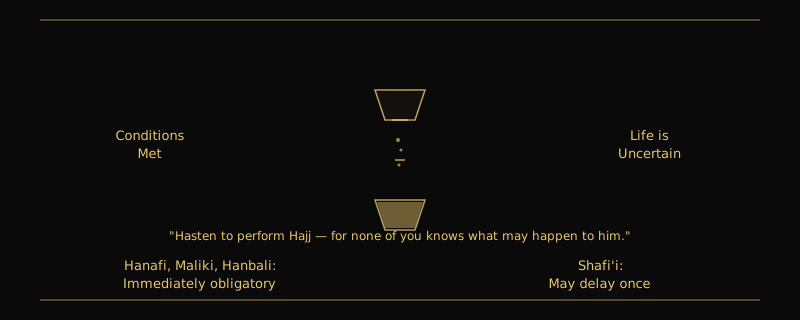
Once a person meets all the conditions of obligation, can they delay performing Hajj to a later year? This is a significant question with practical consequences.
"Hasten to perform Hajj - meaning the obligatory one - for none of you knows what may happen to him."
Musnad Ahmad 2869 - Narrated by Ibn Abbas (may Allah be pleased with them both). Also reported in Abu Dawud.Abu Hanifah, Malik, and Ahmad (the majority): Hajj must be performed immediately (fawran) once the conditions are met. Delaying it without a valid excuse is sinful. Their evidence includes the hadith above commanding haste, as well as the report of Umar ibn al-Khattab (may Allah be pleased with him): "I was about to send men to those lands to see who has the means but has not performed Hajj, and to impose the jizyah upon them - they are not Muslims, they are not Muslims."
Imam al-Shafi'i: Hajj is obligatory at a relaxed pace (ala al-tarahi), meaning it may be delayed as long as the person intends to perform it eventually. However, the person is sinful if they die without having performed it while they had the means.
Critical Warning: The majority of scholars hold that delaying Hajj without a valid reason - when one has the health, wealth, and ability - is sinful. Life is uncertain. Health deteriorates. Wealth can vanish. Do not gamble with one of the five pillars of your religion. The Prophet (peace and blessings be upon him) urged haste precisely because "none of you knows what may happen to him."
The scholars have listed legitimate reasons for delay, including: serious illness, genuine safety concerns, the Hajj visa/permit not being available (as with modern quota systems), and having dependents who require one's immediate care with no alternative arrangement possible.
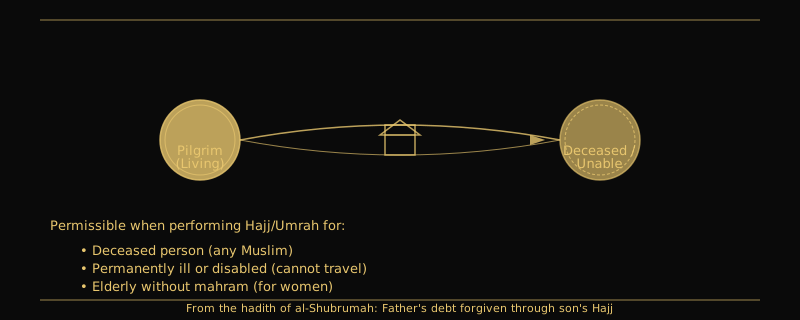
One of Allah's mercies upon this Ummah is that Hajj may be performed on behalf of another person under certain circumstances.
Ibn Abbas (may Allah be pleased with them both) narrated: The Prophet (peace and blessings be upon him) heard a man saying during Hajj: "Labbayk on behalf of Shubrumah." The Prophet asked: "Who is Shubrumah?" The man said: "A brother of mine" (or "a relative of mine"). The Prophet asked: "Have you performed Hajj for yourself?" The man said: "No." The Prophet said: "Perform Hajj for yourself first, then perform it on behalf of Shubrumah."
Sunan Abu Dawud 1811, Sunan Ibn Majah 2903 - Narrated by Ibn Abbas (may Allah be pleased with them both)A woman from the tribe of Khath'am said: "O Messenger of Allah, the obligation of Hajj has come upon my father when he is an old man who cannot sit firmly on the mount. Shall I perform Hajj on his behalf?" He said: "Yes."
Sahih al-Bukhari 1513, Sahih Muslim 1334 - Narrated by Ibn Abbas (may Allah be pleased with them both)Practical Tip: If you are performing Hajj on behalf of a deceased relative, say in your Talbiyah: "Labbayk Allahumma Hajjan 'an [name of the person]" - "Here I am, O Allah, performing Hajj on behalf of [name]." This should be said at the point of entering Ihram.
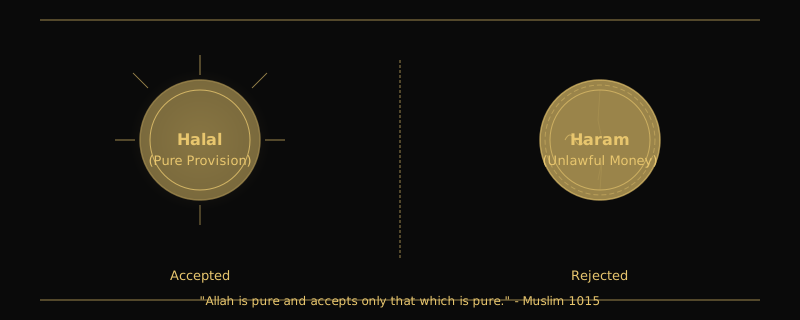
The purity of one's provision is a critical factor in the acceptance of all acts of worship, and Hajj is no exception. In fact, because Hajj involves financial expenditure at every stage - travel, food, accommodation, sacrifice - the source of one's funds is of paramount importance.
Abu Hurairah (may Allah be pleased with him) reported that the Prophet (peace and blessings be upon him) said: "Allah is Pure (Tayyib) and accepts only what is pure." Then he mentioned a man who, having journeyed far, is dishevelled and dusty. He raises his hands to the sky saying: "O Lord! O Lord!" - while his food is unlawful (haram), his drink is unlawful, his clothing is unlawful, and he is nourished with the unlawful. "So how can his supplication be answered?"
Sahih Muslim 1015 - Narrated by Abu Hurairah (may Allah be pleased with him)The scholars have explained that the man described in this hadith has all the outward signs of a supplicant whose du'a should be answered - he has travelled far (hardship), he is dishevelled (humility), and he is raising his hands to the sky (proper etiquette of du'a). Yet his du'a is rejected because his provision is from haram sources.
Critical Warning: A pilgrim who performs Hajj with unlawful money is committing a grave sin. While the majority of scholars (Hanafi, Shafi'i, Hanbali) hold that the Hajj may technically be valid in the sense that the obligation is fulfilled, it will be devoid of blessing and reward. The pilgrim will bear the sin of the unlawful earnings on top of the effort. Imam Ahmad and some Hanbali scholars held a stricter view that such a Hajj may not fulfil the obligation at all.
Since Hajj is only obligatory upon those who have the financial means, taking a loan to fund Hajj is not required and not recommended. The scholars have stated that a person who does not have the money for Hajj is not considered "able" (mustati') and is thus exempt from the obligation.
When asked about a man who does not have the means for Hajj, the Prophet (peace and blessings be upon him) indicated that he is not obligated to go into debt for it.
Reported in various narrations. See Sunan Abu Dawud and the explanations of the scholars regarding istitaa'ah (ability).Practical Tip: Before performing Hajj, take an honest account of your finances. Ensure your Hajj funds are from halal (lawful) sources. If you have outstanding debts, consult a scholar about whether you should perform Hajj or repay your debts first. If you have mixed funds, purify your wealth by repenting and giving charity before embarking.
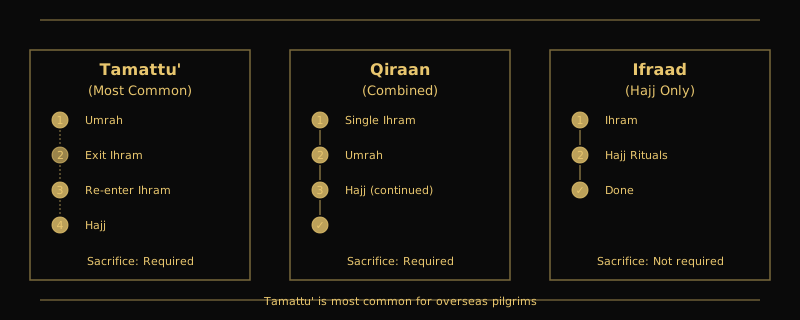
A pilgrim must choose one of three methods of performing Hajj before entering the state of Ihram. Each method has different rules regarding Ihram, sacrifice, and the performance of Umrah. Understanding these three types is essential for every pilgrim.
| Aspect | Tamattu' | Qiraan | Ifraad |
|---|---|---|---|
| Meaning | "Enjoyment" - enjoying the break between Umrah and Hajj | "Combining" - joining Umrah and Hajj together | "Singling out" - performing Hajj alone |
| Procedure | Perform Umrah first, exit Ihram completely, then enter new Ihram for Hajj on 8th Dhul Hijjah | Enter Ihram for both Umrah and Hajj together from the Miqat. Do not exit Ihram between them | Enter Ihram for Hajj only. No Umrah is performed before it |
| Number of Ihrams | Two (one for Umrah, one for Hajj) | One continuous Ihram | One Ihram |
| Animal Sacrifice (Hady) | Obligatory (or fast 10 days if unable) | Obligatory (or fast 10 days if unable) | Not required (but recommended) |
| Tawaf & Sa'ee | Two sets (one for Umrah, one for Hajj) | One set suffices for both | One set for Hajj |
| Best for | Overseas pilgrims who arrive early | Those bringing a sacrificial animal | Residents of Makkah |
Tamattu' means performing Umrah during the months of Hajj (Shawwal, Dhul Qa'dah, or the first days of Dhul Hijjah), then exiting Ihram completely and enjoying normal life - wearing regular clothes, using perfume, etc. - until the 8th of Dhul Hijjah, when the pilgrim enters a new Ihram for Hajj.
This is the type the Prophet (peace and blessings be upon him) recommended for those who did not bring a sacrificial animal with them:
"If I had known beforehand what I know now, I would not have brought the sacrificial animal, and I would have made it an Umrah (i.e., performed Tamattu'). So whoever among you does not have a sacrificial animal, let him exit Ihram and make it an Umrah."
Sahih al-Bukhari 1651, Sahih Muslim 1216 - Narrated by Jabir (may Allah be pleased with him)For Tamattu', the sacrifice of a sheep, goat, or one-seventh share of a cow or camel is obligatory. If the pilgrim cannot afford the sacrifice, they must fast three days during Hajj (preferably before the Day of Arafah) and seven days after returning home, totalling ten days. This is based on the verse: "...whoever performs Umrah during the Hajj season shall make an offering such as he can afford; but if he cannot, he shall fast three days during the Hajj and seven days after his return home, making ten days in all" (Quran 2:196).
Qiraan means entering Ihram with the intention of performing both Umrah and Hajj together. The pilgrim says at the Miqat: "Labbayk Allahumma Umratan wa Hajjan" - "Here I am, O Allah, for Umrah and Hajj." The pilgrim remains in Ihram continuously from the Miqat until they complete all the rites of Hajj. The Tawaf and Sa'ee of Umrah are incorporated into those of Hajj. An animal sacrifice is also obligatory for the Qiraan pilgrim.
This was the type of Hajj the Prophet (peace and blessings be upon him) himself performed, because he had brought his sacrificial animal (hady) with him from Madinah, and one who brings the hady cannot exit Ihram until the Day of Sacrifice (10th Dhul Hijjah).
Ifraad means entering Ihram solely for Hajj, with no Umrah before or combined with it. The pilgrim says: "Labbayk Allahumma Hajjan" - "Here I am, O Allah, for Hajj." This is the simplest form and does not require an animal sacrifice (though it is recommended). This type is most common among residents of Makkah, who can perform Umrah at any other time of the year.
Hanafi: Qiraan is the best type, because the Prophet (peace and blessings be upon him) himself performed Qiraan.
Maliki: Ifraad is the best type, because it dedicates the Ihram entirely to Hajj without mixing it with Umrah, and it was the type performed by Abu Bakr and Umar (may Allah be pleased with them).
Shafi'i and Hanbali: Tamattu' is the best type for those who did not bring a sacrificial animal, based on the explicit wish of the Prophet (peace and blessings be upon him) that he had performed Tamattu' instead.
Practical Note: Most overseas pilgrims today perform Tamattu', as it is the easiest and most flexible option and was recommended by the Prophet (peace and blessings be upon him) for those coming from afar.
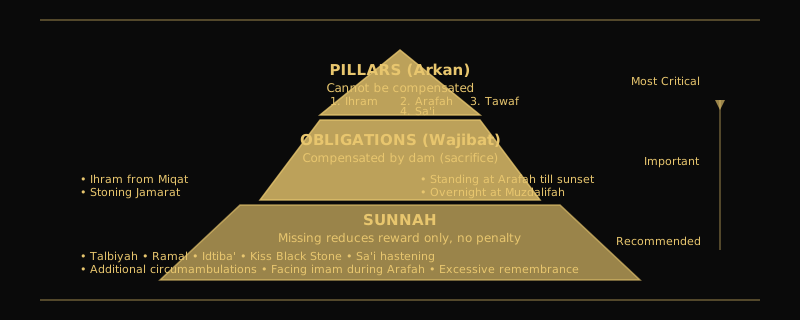
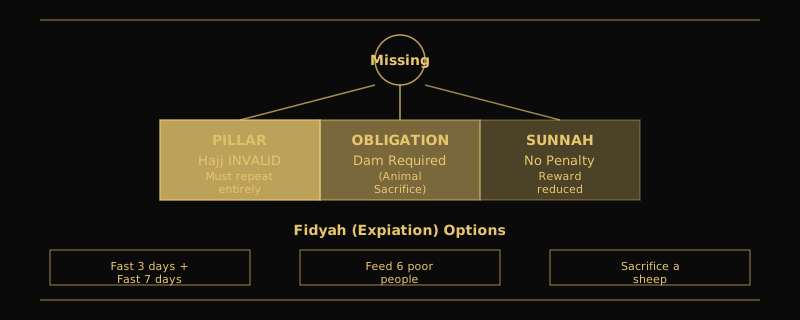
Understanding the distinction between the pillars, obligations, and recommended acts of Hajj is absolutely critical. This knowledge determines what invalidates your Hajj entirely, what requires a penalty to compensate, and what simply reduces your reward if missed. Ibn Qudamah discussed these categories extensively in al-Mughni, and al-Nawawi in al-Majmu'.
Critical Warning: Failing to understand these categories can lead to a pilgrim unknowingly invalidating their entire Hajj. Study this section carefully before you travel.
The pillars (arkan) are the essential components of Hajj. If any one of them is missed, the Hajj is invalid and cannot be compensated by any sacrifice, fasting, or charity. The pilgrim must either complete the missed pillar or repeat the Hajj entirely.
| # | Pillar (Rukn) | Description | Evidence |
|---|---|---|---|
| 1 | Ihram (Niyyah) | Entering the sacred state with the sincere intention of performing Hajj. Without the intention, there is no Hajj. The Prophet (peace and blessings be upon him) said: "Actions are but by intentions" (Bukhari 1, Muslim 1907). | Bukhari 1, Muslim 1907 |
| 2 | Standing at Arafah (Wuquf) | Being present at the plain of Arafah for any amount of time between the afternoon of the 9th of Dhul Hijjah and the dawn of the 10th. This is the greatest pillar. The Prophet (peace and blessings be upon him) said: "Hajj is Arafah" (Tirmidhi 889). Whoever misses Arafah has missed Hajj entirely. | Tirmidhi 889, Nasai 3016 |
| 3 | Tawaf al-Ifadah (Tawaf al-Ziyarah) | The main Tawaf of Hajj, performed after standing at Arafah and after the initial release from Ihram on the 10th of Dhul Hijjah (or after). This is based on the verse: "Then let them complete their prescribed duties and perform their vows, and circumambulate the Ancient House" (Quran 22:29). | Quran 22:29, Bukhari 1733 |
| 4 | Sa'ee between Safa and Marwah | Walking seven times between the hills of Safa and Marwah, commemorating Hajar's (peace be upon her) search for water. The Prophet (peace and blessings be upon him) said: "Perform Sa'ee, for Allah has prescribed Sa'ee for you" (Musnad Ahmad 27322). | Quran 2:158, Musnad Ahmad 27322 |
The obligations (wajibat) are acts that are required but, if missed, can be compensated by offering a sacrifice (damm) - typically a sheep or goat slaughtered in Makkah and distributed to the poor. The Hajj remains valid, but the pilgrim has committed an error that must be rectified.
| # | Obligation (Wajib) | Description |
|---|---|---|
| 1 | Entering Ihram from the Miqat | The pilgrim must enter Ihram at or before the designated Miqat (boundary station) for their route. Passing the Miqat without Ihram requires returning to the Miqat or offering a sacrifice. |
| 2 | Standing at Arafah until sunset | For those who arrive at Arafah during the daytime, they must remain until after sunset. Leaving before sunset without returning requires a sacrifice (according to the Hanbali school). |
| 3 | Spending the night at Muzdalifah | After departing Arafah, pilgrims must spend at least part of the night at Muzdalifah. The minimum is being present there for any part of the second half of the night, according to most scholars. |
| 4 | Spending the nights of Tashriq at Mina | The nights of the 11th, 12th, and (for those who stay) 13th of Dhul Hijjah must be spent at Mina. If one departs on the 12th after pelting, this is permissible ("Then whoever hastens [departure] in two days, there is no sin upon him" - Quran 2:203). |
| 5 | Pelting the Jamarat | Throwing pebbles at the stone pillars (Jamarat): the large Jamarah on the 10th, and all three on the 11th, 12th, and 13th. Seven pebbles at each, saying "Allahu Akbar" with each throw. |
| 6 | Shaving or cutting the hair | After pelting on the 10th, men must shave their heads (halq) or shorten their hair (taqsir). Shaving is preferred. Women cut a fingertip's length from their hair. The Prophet (peace and blessings be upon him) supplicated three times for those who shave and once for those who shorten (Bukhari 1727, Muslim 1301). |
| 7 | Farewell Tawaf (Tawaf al-Wada') | The final Tawaf before leaving Makkah. The Prophet (peace and blessings be upon him) said: "Let none of you depart until the last thing they do is [Tawaf] around the House" (Muslim 1327). Women in menstruation are excused from this. |
The Sunnah acts are recommended and carry additional reward, but there is no penalty or sacrifice required if they are missed. However, the pilgrim should strive to follow the Sunnah of the Prophet (peace and blessings be upon him) as closely as possible.
The majority (Maliki, Shafi'i, Hanbali): Sa'ee between Safa and Marwah is a pillar (rukn) of Hajj. If missed, the Hajj is incomplete and the pilgrim remains in a state of partial Ihram until it is performed.
Hanafi: Sa'ee is a wajib (obligation), not a rukn. If missed, it can be compensated by a sacrifice (damm), though performing it remains strongly required. This is based on their interpretation that only the Quran can establish a rukn, and the Quranic wording about Safa and Marwah uses the phrase "there is no blame" (Quran 2:158), which they argue indicates a lesser degree of obligation.
Hanafi and Hanbali: Tawaf al-Wada' is wajib. Missing it requires a sacrifice.
Shafi'i: It is wajib according to the stronger opinion.
Maliki: It is sunnah (recommended), and missing it does not require a penalty.
The distinction between pillars, obligations, and sunnah acts teaches us something profound about worship: Allah has made the essential requirements few and manageable, but has opened wide doors for those who wish to draw closer to Him through additional devotion. The one who does only the minimum will have their Hajj accepted, but the one who adorns their Hajj with every sunnah is building a palace in Paradise with every extra step, every extra supplication, every moment spent in remembrance of Allah.
Hajj has a detailed system of penalties (expiations) for violations and omissions. Understanding this system is important because mistakes can and do happen during Hajj, especially given the crowds, heat, and exhaustion. The pilgrim should know what to do if something goes wrong.
Allah says in the Quran:
"And whoever among you is ill or has an ailment of the head [making shaving necessary], then a ransom of fasting [three days] or charity [feeding six poor persons] or sacrifice [of a sheep]."
Quran 2:196This verse establishes the three-tiered penalty system for Ihram violations: fasting, feeding the poor, or sacrificing an animal.
If a pilgrim violates one of the prohibitions of Ihram - such as cutting hair, trimming nails, wearing perfume, or wearing sewn clothing (for men) - the penalty is one of the following three options (the pilgrim chooses):
| Option | Description |
|---|---|
| Fast 3 days | These can be fasted anywhere - in Makkah or after returning home |
| Feed 6 poor people | Each person receives half a sa' of food (approximately 1.5 kg of staple food such as rice or wheat) |
| Sacrifice a sheep | A sheep or goat must be slaughtered and distributed to the poor of the Haram area |
This is known as fidyah al-adha (ransom), based on the hadith of Ka'b ibn 'Ujrah (may Allah be pleased with him), who was troubled by lice during Ihram. The Prophet (peace and blessings be upon him) allowed him to shave his head and offered him these three options (Bukhari 1814, Muslim 1201).
If a pilgrim misses any of the seven obligations listed above (e.g., failing to spend the night at Muzdalifah, missing the pelting, leaving Makkah without Tawaf al-Wada'), the penalty is:
Sacrifice a sheep or goat (damm) in Makkah and distribute the meat to the poor of the Haram. If unable to sacrifice, the pilgrim must fast 10 days (3 during Hajj and 7 upon return home), following the same principle as the Tamattu' sacrifice.
Most Severe Violation - Before Standing at Arafah: If a pilgrim engages in marital intimacy (sexual intercourse) before standing at Arafah, the consequences are the most severe of all Hajj violations:
This ruling is based on the consensus of the Companions, including the fatwa of Ibn Abbas, Ibn Umar, and others (may Allah be pleased with them all). Ibn Qudamah stated in al-Mughni that there is no known disagreement among the scholars on this matter.
After Standing at Arafah but Before Full Release from Ihram: If marital intimacy occurs after standing at Arafah but before the first tahallul (initial release from Ihram, which occurs after doing two of the three acts on the 10th: pelting, shaving, and Tawaf), then:
If it occurs after the first tahallul but before Tawaf al-Ifadah, the majority hold that it requires a sacrifice of a sheep, and the pilgrim must exit the Haram area to re-enter Ihram and complete the Tawaf.
Hunting land animals while in the state of Ihram is strictly prohibited. Allah says: "O you who have believed, do not kill game while you are in the state of Ihram" (Quran 5:95). The penalty is to sacrifice an animal equivalent to what was hunted (as judged by two just persons), or to feed the poor with its equivalent value, or to fast an equivalent number of days.
| Violation | Penalty | Hajj Status |
|---|---|---|
| Ihram restriction (perfume, cutting hair, etc.) | Fast 3 days, OR feed 6 poor, OR sacrifice a sheep | Valid |
| Missing a wajib act | Sacrifice a sheep/goat (or fast 10 days) | Valid |
| Intimacy before Arafah | Sacrifice a camel + complete rites + repeat Hajj next year | INVALID |
| Intimacy after Arafah, before 1st tahallul | Sacrifice a camel | Valid |
| Intimacy after 1st tahallul, before Tawaf al-Ifadah | Sacrifice a sheep (majority opinion) | Valid |
| Hunting in Ihram | Equivalent animal, OR feed poor, OR fast equivalent days | Valid |
Practical Tip: If you commit a violation during Hajj and are unsure of the penalty, do not panic. Seek out a scholar or the fatwa service available at the Haram. Many Hajj groups have a designated scholar who can guide you. Document what happened so you can describe it accurately. Remember that Islam is a religion of ease: "Allah intends for you ease and does not intend for you hardship" (Quran 2:185).
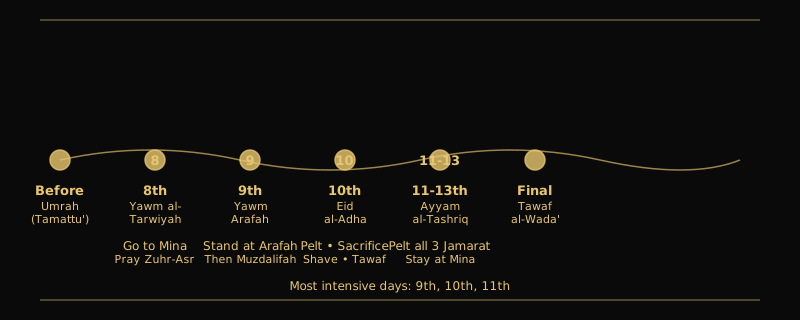
The rites of Hajj span several days, each with its own significance and obligations. Below is a comprehensive timeline. Each of these days will be covered in much greater detail in the dedicated Hajj chapters, but this overview gives you the complete picture so you can see how all the pieces fit together.
Pilgrims performing Tamattu' arrive in Makkah during the months of Hajj (Shawwal, Dhul Qa'dah, or early Dhul Hijjah) and perform Umrah first: Tawaf, Sa'ee, and shaving/cutting the hair. They then exit Ihram and wait in Makkah in their normal clothes until the 8th of Dhul Hijjah.
This is the busiest day of Hajj. Four major acts are performed, and their recommended order is:
The Sunnah order is: pelting, then sacrifice, then shaving, then Tawaf. However, the Prophet (peace and blessings be upon him) was asked about people who performed these acts out of order, and he said regarding each case: "Do it, and there is no harm" (Bukhari 83, Muslim 1306). The majority of scholars therefore hold that performing them out of order is permissible without penalty, though following the Sunnah order is preferred.
Practical Tip: Tawaf al-Ifadah does not have to be performed on the 10th. Many scholars recommend delaying it to the 11th or 12th when the Haram is less crowded. It can be performed any time before the end of Dhul Hijjah (though delaying beyond the days of Tashriq without excuse is disliked by some scholars).
Before leaving Makkah, the pilgrim must perform the Farewell Tawaf (Tawaf al-Wada'). This should be the very last thing the pilgrim does in Makkah - no shopping, no visiting, no lingering after it. The Prophet (peace and blessings be upon him) said: "Let none of you depart until the last thing they do is [Tawaf] around the House" (Sahih Muslim 1327).
Women who are menstruating at the time of departure are excused from Tawaf al-Wada'. This is based on the hadith of Ibn Abbas: "The people were commanded that the last thing they should do is [Tawaf] around the House, except that this was waived for the menstruating woman" (Bukhari 1755, Muslim 1328).
The journey of Hajj mirrors the journey of life itself. You begin with preparation and intention - just as your parents prepared for your arrival in this world. You stand before Allah stripped of everything on the plains of Arafah - just as you will stand before Him on the Day of Judgement. You sacrifice what you love - just as Ibrahim (peace be upon him) was willing to sacrifice his beloved son. You pelt the Shaytan - just as you must resist his whispers every day of your life. And you return home, cleansed of sins, born anew - just as you will, by Allah's mercy, enter Paradise purified.
Every step of Hajj is a lesson. Every rite is a reminder. The one who performs Hajj with awareness and reflection will find that they have lived an entire lifetime of spiritual growth in just a few days.
Test your knowledge of the rulings, types, and obligations of Hajj.
Take the Fiqh of Hajj Quiz →The Saudi Ministry of Hajj and Umrah has opened Hajj 2027 preparations with meetings involving Hajj affairs offices from...
Saudi Arabia's Ministry of Hajj and Umrah has launched Direct Umrah, a digital service letting pilgrims at home and abro...
The Umrah 1448 AH season is drawing to a close. Saudi Arabia set September 23 as the final date for Umrah pilgrims to en...
Qatar's Ministry of Awqaf and Islamic Affairs opened Hajj 2027 registration on September 20, running to October 20, for ...