About this page: Women’s fiqh issues during Hajj and Umrah are among the most commonly asked - yet most poorly answered - topics in pilgrimage preparation. This page aims to be a thorough, respectful, and empowering resource. Every answer is drawn exclusively from the Quran, the authentic Sunnah (Sahih al-Bukhari, Sahih Muslim, Abu Dawud, Tirmidhi, Nasai, Ibn Majah, Musnad Ahmad), and the four Sunni schools of jurisprudence (Hanafi, Maliki, Shafi’i, Hanbali). Where scholars differ, we present the positions clearly so you can follow your own madhab or consult your scholar with confidence.
Aishah (RA) reported that the Prophet ﷺ said: “Upon them is a jihad in which there is no fighting: Hajj and Umrah.”
- Ibn Majah 29011. Ihram & Clothing
What should women wear for Ihram?
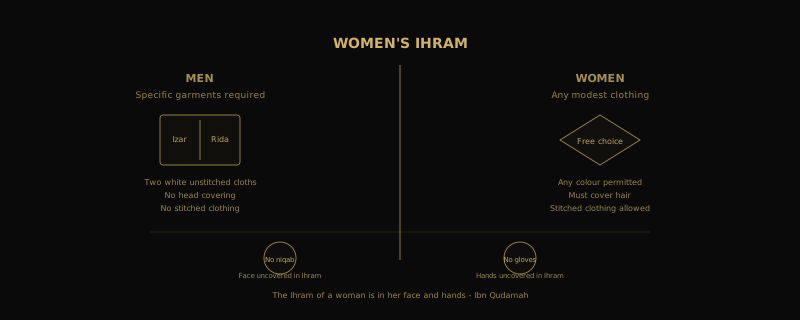
Women enter Ihram in their normal modest clothing. There is no specific “Ihram outfit” for women the way there is for men (who wear two unstitched white sheets). A woman may wear any loose, modest garment that covers her body - an abaya, a shalwar kameez, a long skirt with a top, or any similar clothing. Her head must be covered with a hijab or khimar, but her face and hands must remain uncovered while in the state of Ihram.
Ibn Umar (RA) reported that the Prophet ﷺ said: “A woman in Ihram should not wear a niqab (face veil) and should not wear gloves.”
- Sahih al-Bukhari 1838Practical tip: Many women find a loose, dark-coloured abaya to be the most comfortable and practical option. Avoid tight or see-through clothing. Bring at least two sets so you can change if one gets dirty or sweaty during the rites.
Can women wear sewn clothes in Ihram?
Yes. This is one of the most common misconceptions. The prohibition on wearing makhit (sewn or tailored garments) applies only to men. Women are required to wear normal, stitched, modest clothing. In fact, a woman wearing unstitched garments that fail to cover her properly would be violating the rules of hijab. The Prophet ﷺ specifically addressed men when he said: “Do not wear shirts, turbans, trousers, hooded cloaks, or leather socks” (Sahih al-Bukhari 1838). Women were not addressed with these restrictions.
Can women wear makeup in Ihram?
No. Wearing makeup - including foundation, lipstick, eyeliner (kohl), and mascara - is not permitted while in the state of Ihram. This falls under the general prohibition of beautification and adornment during Ihram. If makeup is applied before entering Ihram, it should be removed or washed off before making the intention. After exiting the state of Ihram (by completing all rites and shaving/trimming the hair), makeup becomes permissible again.
Practical tip: Some women use plain, unscented moisturiser or lip balm to prevent dryness in the desert heat. Most scholars permit unscented skincare products as they serve a medical or protective purpose rather than beautification. Consult your scholar if unsure.
Can women wear perfume before or during Ihram?
A woman may apply perfume to her body before entering Ihram, just as men do. The Prophet ﷺ would apply perfume before entering Ihram. Aishah (RA) said: “I used to apply perfume to the Messenger of Allah ﷺ for his Ihram before he entered Ihram, and for his exiting Ihram before he did Tawaf of the House.” (Sahih al-Bukhari 1539, Sahih Muslim 1189). However, once in the state of Ihram, applying new perfume is prohibited for both men and women. Avoid scented soap, scented deodorant, and perfumed body lotion during Ihram.
Important: While you may apply perfume to your body before Ihram, be careful not to apply it to your Ihram clothing itself. The lingering scent on your body from pre-Ihram application is fine, but deliberately scenting your garments is a point of scholarly discussion - it is safer to avoid it.
What about wearing shoes and socks?
Women may wear any shoes or socks they wish during Ihram. The restriction on footwear (not wearing khufoof/leather socks that cover the ankle) applies to men only. Women can wear closed shoes, sandals, trainers, socks, or any footwear that is comfortable. Given the enormous amount of walking involved in Hajj and Umrah, comfortable, well-broken-in shoes are essential.
Practical tip: Wear sturdy, comfortable walking shoes or trainers with good arch support. Avoid brand-new shoes - break them in weeks before your trip. Many women bring flip-flops for the hotel and a pair of supportive shoes for the rites. Socks help prevent blisters.
Can women wear jewellery during Ihram?
The majority of scholars permit women to wear jewellery during Ihram, including rings, bracelets, earrings, and necklaces, as there is no specific prohibition against it. However, it should not be displayed to non-mahram men, which is the general rule of modesty that applies at all times. Some scholars recommend minimising jewellery as a precaution against theft in the large crowds and to maintain the spirit of simplicity that Ihram represents.
Wearing jewellery during Ihram is permissible for women but should be concealed under clothing. The purpose of Ihram is humility before Allah, and excessive adornment is discouraged though not forbidden.
What colour clothing should women wear for Ihram?
There is absolutely no restriction on colour. Women may wear black, white, green, blue, brown, grey, or any colour they choose. The widespread belief that women must wear white for Ihram is a cultural myth with no basis in the Quran or Sunnah. The companions’ wives and daughters wore various colours during their pilgrimages. Many women find dark colours more practical as they show less dirt and provide better coverage.
Misconception alert: You do NOT need to wear white. In some cultures, women are pressured to wear white for Ihram. This has no scholarly basis whatsoever. Wear whatever modest clothing is most comfortable for you.
Can women wear the niqab during Ihram?
No. A woman in Ihram is prohibited from wearing the niqab (face veil) and gloves, as explicitly stated in the hadith of Ibn Umar (RA) in Sahih al-Bukhari 1838. However, this does not mean a woman’s face must be exposed to non-mahram men. Aishah (RA) described the practice of the women companions: “Riders would pass by us while we were with the Messenger of Allah ﷺ in Ihram. When they came alongside us, one of us would let her jilbab hang down from her head over her face, and when they had passed, we would uncover.” (Abu Dawud 1833).
Practical method: Women who normally cover their face can use a cap or visor on their forehead and drape a loose cloth over it so that the fabric hangs in front of the face without touching the skin. This was the method practised by Aishah (RA) and other women of the Sahabah. Many modern “Ihram niqabs” or “face shades” are available for this purpose.
What about hair covering during Ihram?
A woman must cover her hair during Ihram, just as she must at all other times in front of non-mahram men. The head covering is not removed for Ihram - that is a rule for men only (men must keep their heads uncovered). Women should wear a proper hijab, khimar, or headscarf that covers all of their hair. If any hair becomes accidentally exposed, simply cover it back - there is no penalty. The key restriction is only on the face and hands: these must remain uncovered (i.e., no niqab and no gloves).
2. Menstruation & Post-Natal Bleeding
This is arguably the most important section on this entire page. Menstruation is a natural bodily function that Allah created, and no woman should feel ashamed or spiritually diminished because of it. The Prophet ﷺ himself addressed these issues with Aishah (RA) with gentleness and clarity. Understanding these rulings will remove unnecessary anxiety and allow you to complete your Hajj or Umrah with confidence.
What if I get my period during Umrah?
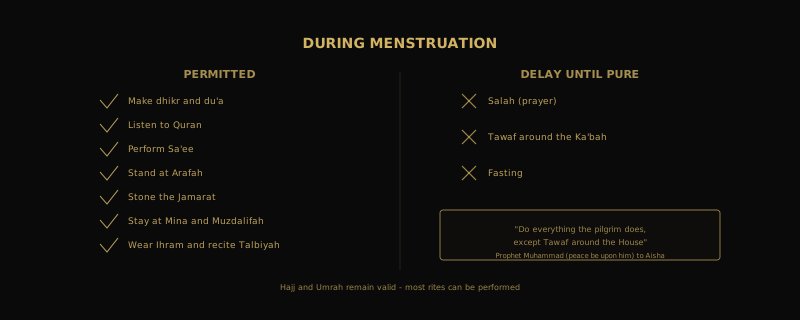
If your period starts during Umrah, you can do everything except Tawaf. Tawaf requires a state of ritual purity (wudu and being free from menstruation), so you must wait. Once your period ends, perform ghusl (the full ritual bath), then complete your Tawaf and Sa’ee. You remain in the state of Ihram until you finish all the rites. This is exactly what the Prophet ﷺ told Aishah (RA) when she began menstruating on the way to Makkah:
The Prophet ﷺ said to Aishah (RA): “This is something that Allah has decreed for the daughters of Adam. Do everything that the pilgrim does, but do not perform Tawaf around the House until you are clean.”
- Sahih al-Bukhari 305, Sahih Muslim 1211Practical tip: If you are on a tight schedule (e.g., your flight is soon), speak to your group leader. In extreme cases where waiting is not possible, consult a qualified scholar about the dispensations available. Do not panic - most Umrah trips have enough flexibility to wait a few days.
What if I get my period during Hajj?
This is the scenario that causes the most anxiety, but the ruling is clear and reassuring: you can do everything except Tawaf. If your period begins on or before the Day of Arafah (9th Dhul Hijjah), there is no problem at all - standing at Arafah does not require wudu or purity from menstruation. You go to Muzdalifah, collect your pebbles, go to Mina, pelt the Jamarat, sacrifice, trim your hair - all of this is permissible. The only thing delayed is Tawaf al-Ifadah (the obligatory Tawaf of Hajj), which you perform once your period ends and you have done ghusl.
Critical ruling: Do NOT skip Tawaf al-Ifadah. It is a pillar (rukn) of Hajj - your Hajj is not complete without it. If your period prevents you from doing it during the days of Hajj, you remain in a partial state of Ihram (where intimacy with your spouse is not yet permitted) until you can do the Tawaf. Coordinate with your group to find a time to return and complete it.
Can I enter Masjid al-Haram during menstruation?
The majority of scholars (Hanafi, Maliki, Shafi’i) hold that a menstruating woman may not stay in the mosque, based on the hadith: “I do not permit the mosque for a menstruating woman or one who is junub (in a state of major impurity).” (Abu Dawud 232, Ibn Majah 645). However, passing through is treated differently by some scholars.
Some Hanbali scholars permit a menstruating woman to pass through the mosque if she needs to (based on the hadith where the Prophet ﷺ told Aishah to bring him the prayer mat from the mosque while she was menstruating - Sahih Muslim 298). However, staying or sitting in the mosque is not permitted.
If possible, avoid entering Masjid al-Haram during your period. Use the time for dua and dhikr in your hotel room. If you must pass through the courtyard or outer areas to reach your accommodation, this is a point of scholarly leniency.
Can I make dua and dhikr during menstruation?
Absolutely yes. There is no restriction whatsoever on making dua (supplication), dhikr (remembrance of Allah), tasbeeh, tahmeed, takbeer, sending salawat upon the Prophet ﷺ, or any other form of verbal worship during menstruation. The only acts restricted are prayer (salah), fasting, Tawaf, and (according to some scholars) touching the mushaf. You should make the most of your time by engaging in abundant dua, especially on the Day of Arafah and during the blessed nights.
The Prophet ﷺ said to Aishah (RA) when she was menstruating during Hajj: “Do everything that the pilgrim does, but do not perform Tawaf around the House until you are clean.”
- Sahih al-Bukhari 305Encouragement: Dua is the essence of worship. Many scholars say it is the single most powerful act a believer can do. Your period does not diminish your connection to Allah in the slightest. Pour your heart out in supplication - in the hotel, in the courtyard, wherever you are. Allah hears every word.
Can I recite Quran during menstruation?
This is a matter of scholarly difference, but the majority of contemporary scholars permit a menstruating woman to recite the Quran from memory or from a device (phone, tablet) without touching the physical mushaf. Sheikh Ibn Taymiyyah, Sheikh Ibn Baz, and Sheikh Ibn Uthaymeen all held that there is no authentic, explicit prohibition on a menstruating woman reciting Quran. The hadith often cited (“Neither the menstruating woman nor the one who is junub should recite anything from the Quran” - Tirmidhi 131) has been graded weak by many hadith scholars.
The classical position in these three madhabs is that a menstruating woman should not recite the Quran. However, many later scholars within these schools have permitted it, especially for the purpose of study, teaching, or memorisation - and particularly for a woman on Hajj who should not be deprived of this worship during the blessed days.
The Hanbali madhab permits a menstruating woman to recite Quran if she fears forgetting it. Sheikh Ibn Taymiyyah went further and said there is no authentic prohibition at all. This is the view adopted by many contemporary scholars worldwide. Reading from a phone or tablet avoids the issue of touching the mushaf entirely.
Can I do Sa’ee during menstruation?
There is a scholarly difference on this point, and understanding it will help you plan practically:
Sa’ee does not require wudu or purity from menstruation. Aishah (RA) reported that the Prophet ﷺ said regarding Sa’ee: “Sa’ee between Safa and Marwah is from the rites of Allah, and there is no harm upon the one who does Sa’ee between them.” The area of Sa’ee is technically not part of the mosque. According to this view, a menstruating woman may perform Sa’ee.
The Hanafi madhab considers wudu to be wajib (necessary) for Sa’ee, and therefore a menstruating woman should not perform it until she is clean. Omitting wudu for Sa’ee in the Hanafi madhab would require a dam (sacrificial animal) as compensation, though the Sa’ee itself would still be valid.
Practical advice: If time permits, wait until your period ends and you have done ghusl, then do both Tawaf and Sa’ee together. If you are pressed for time (e.g., your group is leaving), many scholars permit doing Sa’ee while menstruating. Consult your own scholar or group imam for guidance specific to your situation.
What if my period starts during Tawaf?
If your menstruation begins while you are in the middle of Tawaf, you must stop immediately and leave the Tawaf area. You cannot continue, as Tawaf requires a state of ritual purity. What happens next depends on your madhab:
You must restart Tawaf from the beginning once you are clean and have performed ghusl. The circuits you completed before your period do not count, and you begin a fresh set of seven circuits.
You may resume from where you stopped once you are clean and have performed ghusl. If you completed four circuits, you would continue from the fifth. This is the more lenient view and is often applied in cases of hardship.
Practical tip: Note which circuit you were on when you stopped. After becoming clean and doing ghusl, return to the Black Stone corner and resume (or restart, depending on your madhab). If in doubt, restarting from the beginning satisfies all scholarly opinions.
Can I take medication to delay my period for Hajj?
Yes, this is permissible according to the majority of scholars. Both Sheikh Ibn Baz and Sheikh Ibn Uthaymeen explicitly permitted women to take medication to delay menstruation so they could perform Hajj and Umrah without interruption. Many women travelling for Hajj use hormonal contraceptive pills or norethisterone (prescribed by a doctor) to delay their period. This is a well-established practice.
Medical advice: Consult your doctor well in advance (at least 2–3 months before travel) to discuss the best option for you. Start the medication as directed - some require starting weeks before. Side effects can include nausea, spotting, or mood changes. Trial the medication before your trip to see how your body reacts.
Reassurance: Taking medication to delay your period for Hajj is completely normal and very common. There is no shame in it. Hajj is a once-in-a-lifetime obligation, and using permissible medical means to ensure you can perform all the rites without interruption is a wise and valid choice.
What if I am in post-natal bleeding (nifas)?
Post-natal bleeding (nifas) follows exactly the same rules as menstruation. A woman in nifas can do everything the pilgrim does - stand at Arafah, go to Muzdalifah, pelt the Jamarat, make dua, do dhikr - except Tawaf, which requires purity. Once the bleeding stops and she performs ghusl, she can complete her Tawaf. The maximum duration of nifas is 40 days according to most scholars (Hanafi: 40 days; Shafi’i and Hanbali: 60 days; Maliki: 60–70 days), after which any continued bleeding is treated as istihadhah (irregular bleeding).
What about irregular bleeding (istihadhah)?
Istihadhah is treated completely differently from menstruation. A woman experiencing istihadhah (irregular or chronic bleeding that is not menstrual) is considered to be in a state of ritual purity. She should make wudu for each prayer time, use a pad or protection, and perform all rites normally - including Tawaf, Sa’ee, prayer, and everything else. This is based on the hadith of Aishah (RA) about Fatimah bint Abi Hubaysh, to whom the Prophet ﷺ said:
“That is not menstruation, it is from a blood vessel. When the real menstruation comes, leave the prayer. When it goes, wash the blood from yourself, then pray.”
- Sahih al-Bukhari 228, Sahih Muslim 333How to distinguish: Menstrual blood is typically dark, thick, and has a distinct odour. Istihadhah blood is usually lighter in colour, thinner, and does not have the same characteristics. If you are unsure, consult a knowledgeable female scholar or your doctor before travelling. Understanding your personal cycle is important for Hajj preparation.
Am I excused from the Farewell Tawaf (Tawaf al-Wada’) if menstruating?
Yes. This is a matter of scholarly consensus (ijma’). A menstruating woman is completely excused from the Farewell Tawaf with no penalty, no dam (sacrifice), and no sin. This is explicitly established in the hadith:
Ibn Abbas (RA) said: “The people were ordered to make their last act the Tawaf around the House, except that menstruating women were excused.”
- Sahih al-Bukhari 1755, Sahih Muslim 1328Important distinction: The Farewell Tawaf (Tawaf al-Wada’) is what you are excused from. You are NOT excused from Tawaf al-Ifadah (the obligatory Tawaf of Hajj). If you have not yet done Tawaf al-Ifadah, you must wait until clean, even if it means staying behind after your group leaves. Tawaf al-Ifadah is a pillar of Hajj; the Farewell Tawaf is a wajib that is waived for menstruating women.
What if I become clean during the days of Hajj?
If your period ends during the days of Hajj (10th–13th Dhul Hijjah), perform ghusl immediately and then go to do your Tawaf al-Ifadah as soon as you can. There is no need to wait - once you are clean and have done ghusl, you are in a state of purity and can perform Tawaf. If it is nighttime, the Haram is open 24 hours. Many women find the late night or early morning hours less crowded and more comfortable for Tawaf. After Tawaf al-Ifadah, if you have not yet done Sa’ee, complete it as well.
Practical tip: Keep your Ihram clothing and ghusl supplies ready so that the moment your period ends, you can bathe and go to the Haram without delay. Coordinate with a family member or group member to accompany you, especially at night.
Can I use tampons or menstrual cups during Hajj?
Yes. There is no Islamic prohibition on using tampons, menstrual cups, or any other internal menstrual products. These are simply a means of managing blood flow and have no bearing on your ritual state. Many women find menstrual cups particularly convenient for Hajj because they can be worn for up to 12 hours, reduce the need for frequent bathroom visits, and are more discreet under Ihram clothing. Pads are also perfectly fine. Use whatever you are most comfortable with and whatever you have experience using - Hajj is not the time to try a new product for the first time.
3. Mahram Requirements
Do I need a mahram to perform Hajj?
The Prophet ﷺ said: “No woman should travel except with a mahram, and no man should enter upon her unless she has a mahram with her.” (Sahih al-Bukhari 1862, Sahih Muslim 1341). However, the scholars have differed on the application of this hadith to Hajj specifically:
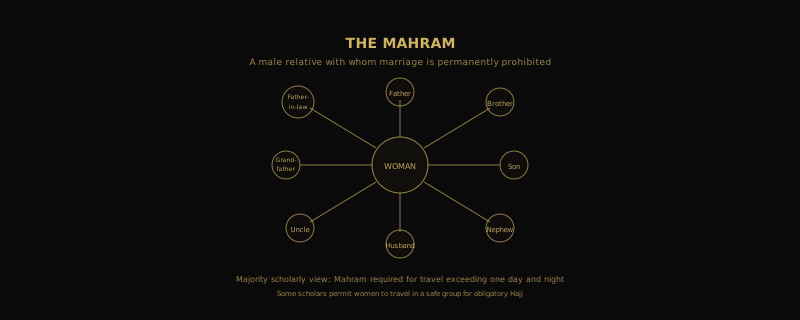
A mahram is strictly required for a woman to perform Hajj. If she has no mahram, Hajj is not obligatory upon her until one becomes available. This is the more cautious view, based on the general wording of the hadith.
A woman may travel for Hajj with a group of trustworthy women even without a mahram, if the journey is safe. Imam al-Nawawi reported that this was the practice of Aishah (RA) and other wives of the Prophet ﷺ during the caliphate of Umar (RA) - they performed Hajj accompanied by Uthman ibn Affan (RA) and Abdur-Rahman ibn Awf (RA), neither of whom was a mahram to all of them. Safety and trustworthiness of the group are the key conditions.
Saudi Regulations (Updated): As of recent years, the Saudi Arabian government has relaxed the mahram requirement for women aged 45 and above travelling in organised groups. Women in this category can obtain a Hajj or Umrah visa and perform pilgrimage with their group without a personal mahram. This is a significant development that has opened the door for many women who previously could not fulfil this obligation.
Who counts as a mahram?
A mahram is a male relative whom a woman can never marry due to blood, marriage, or breastfeeding ties. This includes:
| Category | Examples |
|---|---|
| By blood (nasab) | Father, grandfather, son, grandson, brother, half-brother, paternal uncle, maternal uncle, nephew (brother’s son or sister’s son) |
| By marriage (musaharah) | Husband, father-in-law, stepfather (mother’s husband), son-in-law (daughter’s husband), stepson |
| By breastfeeding (radha’ah) | Milk-brother, milk-father, milk-son, and all corresponding relationships that are forbidden by blood - as the Prophet ﷺ said: “Breastfeeding makes haram what lineage makes haram.” (Sahih al-Bukhari 2645, Sahih Muslim 1447) |
Note: A cousin, a fiancé, a brother-in-law (husband’s brother), or a family friend is NOT a mahram, no matter how trusted. These men can potentially marry the woman, so they do not qualify.
Can my husband be my mahram?
Yes. A husband is a mahram for his wife and is, in fact, the most common mahram for women performing Hajj. He qualifies because a woman cannot marry another man while she is married to him, and the relationship of marriage creates the mahram bond. The husband does not need to be performing Hajj himself - he simply needs to be accompanying her on the journey (though most husbands take the opportunity to perform Hajj as well).
What if I have no mahram available?
If you genuinely have no mahram available - your father has passed away, you have no brothers, no sons, no husband, and no other qualifying relative - then the ruling depends on your madhab:
Hajj is not obligatory upon you until a mahram becomes available. You are not sinful for not performing Hajj. If a mahram never becomes available in your lifetime, you should appoint someone to perform Hajj on your behalf after your death (from your estate).
You may travel with a group of trustworthy women, and Hajj remains obligatory if you can arrange safe travel. The key condition is safety and reliability of the group, not the presence of a specific male relative.
Practical advice: Many Hajj agencies now cater specifically to women travelling without mahrams by arranging all-female groups with female group leaders. Check with the Saudi embassy or your local Hajj authority for the latest regulations regarding women’s travel.
Can women over 45 go without a mahram?
Yes, under current Saudi regulations. Saudi Arabia now permits women aged 45 and above to perform Hajj and Umrah as part of an organised group without a personal mahram. This policy change has been implemented through the official Hajj and Umrah visa systems. Women under 45 travelling without a mahram may still face visa restrictions, though policies continue to evolve. Always check the most current regulations with your country’s Hajj ministry or the Saudi embassy before booking.
Does the mahram need to also be performing Hajj?
No. The mahram’s role is to accompany and protect the woman during travel, not to perform Hajj himself. He can simply be present with her in Makkah and Madinah without entering Ihram or doing any of the rites. However, it would be a tremendous missed opportunity - if he is there, he might as well perform Hajj or Umrah and earn the immense reward. The only requirement is his physical presence to provide companionship and security during the journey.
4. Tawaf & Sa’ee for Women
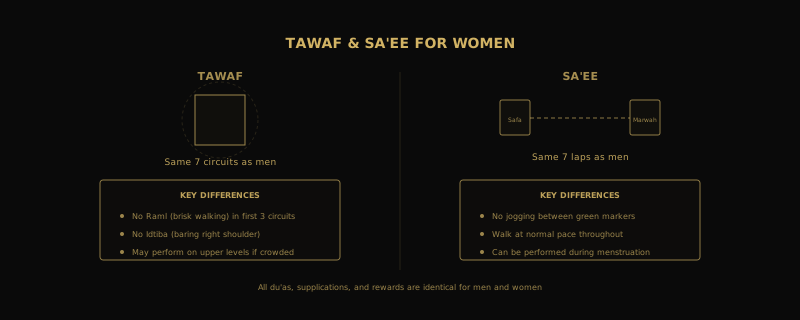
Do women do Raml (brisk walking) in Tawaf?
No. Raml - the brisk, shoulder-swaying walk performed during the first three circuits of Tawaf al-Qudum (Arrival Tawaf) - is prescribed for men only. Women walk at their normal, dignified pace throughout all seven circuits. Ibn Umar (RA) said: “Women do not have to do raml around the Ka’bah or between Safa and Marwah.” This is agreed upon by all four madhabs. Walk calmly, focus on your dua, and take your time.
Do women do Idtiba’ (exposing the right shoulder)?
No. Idtiba’ - the practice of placing the middle of the upper Ihram garment (rida’) under the right armpit and draping it over the left shoulder, thereby exposing the right shoulder - is exclusively for men and only during the Tawaf in which raml is performed (Tawaf al-Qudum). This practice has no application to women whatsoever, as women must keep their bodies covered (except face and hands) at all times. All four madhabs are unanimous on this.
Can women touch or kiss the Black Stone?
Yes, women may touch and kiss the Black Stone (al-Hajar al-Aswad) if they are able to reach it without being crushed, jostled, or harmed in the crowd. Aishah (RA) used to kiss the Black Stone. However, the area around the Black Stone is often extremely crowded, especially during Hajj season. The Prophet ﷺ instructed that women should perform Tawaf at the back of the men’s rows to avoid being crushed.
Ata’ said: “Aishah (RA) used to do Tawaf at a distance from the men, not mixing with them.”
- Sahih al-Bukhari 1618Practical tip: If you cannot reach the Black Stone safely, simply point towards it with your right hand from wherever you are and say “Allahu Akbar” at the start of each circuit. This is the Sunnah when one cannot touch or kiss it. The reward is the same, in sha Allah. Do not risk injury in the crowd - women who do Tawaf during late night hours or on upper floors often find it easier to reach the Stone.
Should women run between the green markers in Sa’ee?
No. The green fluorescent markers between Safa and Marwah indicate the valley (wadi) where men are recommended to walk briskly or jog. This brisk walking is for men only. Women walk at their normal pace throughout the entire Sa’ee, including between the green markers. Ibn Umar (RA) stated that women have no running in Sa’ee. This is agreed upon by all four madhabs.
Is there a separate Tawaf area for women?
There is no formally designated separate area for women during Tawaf. Men and women perform Tawaf in the same Mataf (Tawaf area). However, the upper floors of Masjid al-Haram provide a Tawaf route that is often significantly less crowded and more comfortable for women and families. The ground-floor Mataf, especially near the Ka’bah, can be extremely crowded and physically demanding during peak times.
Practical tip: If you feel overwhelmed by crowds on the ground floor, move to the first or second floor. The circuits are wider (and therefore longer), but the experience is far more peaceful. Many women prefer the rooftop level during less busy times, which offers a beautiful view of the Ka’bah below. Late night (after Isha) and early morning (before Fajr) are generally the least crowded times.
Can women do Tawaf on the upper floors?
Yes, absolutely. Tawaf performed on the upper floors or the roof of Masjid al-Haram is completely valid according to all four madhabs, as long as the circuit goes around the Ka’bah (i.e., you are circling the Ka’bah even though you are above it). This is often the most practical option for women, the elderly, those in wheelchairs, and anyone who finds the ground-floor crowds too intense. The only difference is that the distance is greater, so each circuit takes longer. Many women find this to be a more spiritual experience as it is calmer and less chaotic.
5. Prayer & Worship
Where should women pray in Masjid al-Haram?
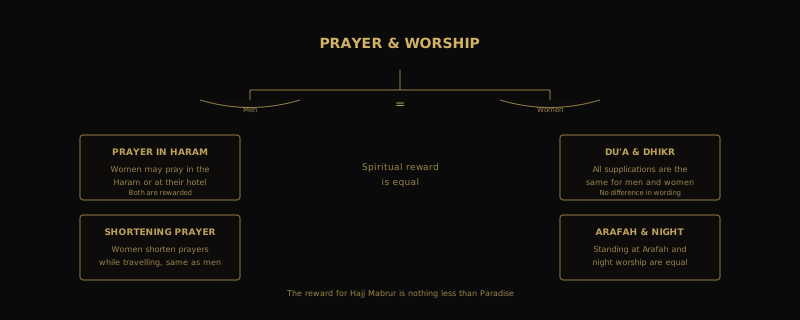
Women may pray anywhere in Masjid al-Haram. There are no gender-segregated prayer areas in the way some local mosques are arranged. Women pray in the Mataf area, in the corridors, on the upper floors, in the basement, and in the outdoor courtyards. During congregational prayers, women generally pray behind the men, as is the Sunnah. The upper floors tend to be more comfortable for women as they are less crowded and provide more personal space. The reward of prayer in Masjid al-Haram is multiplied - the Prophet ﷺ said: “One prayer in this mosque of mine is better than a thousand prayers in any other mosque, except al-Masjid al-Haram.” (Sahih al-Bukhari 1190, Sahih Muslim 1394).
Practical tip: Arrive early for congregational prayers to secure a good spot. Keep a small prayer mat with you as the marble floors can be very hot during the day (especially on the roof) or very cold from air conditioning. Mark your shoes’ location with a distinctive bag - thousands of shoes can look identical.
Can women pray in the Rawdah (in Masjid al-Nabawi)?
Yes. The Rawdah - the blessed garden between the Prophet’s minbar and his noble chamber in Madinah - is open to women, typically during designated time slots (usually in the morning). The Prophet ﷺ said: “Between my house and my minbar is a garden from the gardens of Paradise.” (Sahih al-Bukhari 1195, Sahih Muslim 1391). Women’s time slots are allocated to prevent overcrowding and ensure women can pray comfortably.
Practical tip: Women’s Rawdah times are typically after Fajr or in the late morning - check the current schedule when you arrive in Madinah. The time slots can change, and queues form early. Arrive well ahead of time. The Rawdah is small and demand is high, so be patient. Bring a small dua list so you make the most of your time in this blessed spot.
Should women recite the Talbiyah aloud?
Women should recite the Talbiyah at a moderate volume - audible to themselves and those immediately nearby, but not in a loud, raised voice like men. This is the position of the majority of scholars. The Talbiyah is: “Labbayk Allahumma labbayk, labbayka laa shareeka laka labbayk. Innal-hamda wan-ni’mata laka wal-mulk, laa shareeka lak.”
The scholars agree that men should raise their voices with the Talbiyah, while women should recite it at a level that they can hear themselves. The Talbiyah is an expression of responding to Allah’s call, and women participate in it fully - the difference is only in volume, not in obligation or reward.
Can women lead other women in prayer during Hajj?
Yes. A woman may lead other women in congregational prayer, and this is supported by the practice of the Sahabiyyat (female companions). Aishah (RA) and Umm Salamah (RA) both led women in prayer. The woman leading (imamah) stands in the middle of the first row (not ahead of the row, as a male imam would). This is especially practical during Hajj when a group of women may be praying together in their tent, hotel room, or at a resting point during the rites.
The Shafi’i, Hanbali, and some Hanafi scholars consider it permissible and recommended for a knowledgeable woman to lead other women in prayer. The Maliki position is that it is permissible for voluntary (nafl) prayers but not for obligatory ones, though some Maliki scholars have permitted it for obligatory prayers as well.
Can women recite Quran aloud during Hajj?
Yes. Women may recite the Quran during Hajj - whether silently or aloud. During Tawaf, Sa’ee, standing at Arafah, and throughout the days of Hajj, women can recite Quran, make dua, and engage in all forms of dhikr. When reciting aloud, the same guideline as the Talbiyah applies: at a moderate volume that does not draw unnecessary attention. Many women recite from their phones or from memory during the long hours at Arafah, Muzdalifah, and Mina. The restriction on reciting Quran during menstruation has been discussed in the menstruation section above.
Are there specific duas for women during Hajj?
There are no gender-specific duas in Hajj. The same supplications recited by men are recited by women - including the Talbiyah, the dua at the Black Stone, the dua between the Yemeni Corner and the Black Stone, the dua on Safa and Marwah, the dua at Arafah, and all other prescribed supplications. The Prophet ﷺ said: “The best supplication is the supplication on the Day of Arafah.” (Tirmidhi 3585). This applies equally to men and women. Pour your heart out to Allah in whatever language you are most comfortable with - He understands every language and hears every whisper.
6. Practical & Safety
What should women pack for Hajj and Umrah?
Packing well is one of the most important practical steps for a comfortable pilgrimage. Here is a detailed list tailored specifically for women:
| Category | Items |
|---|---|
| Ihram & Clothing | 2–3 loose abayas or outfits (any colour), multiple hijabs/headscarves, comfortable underwear (yes, normal undergarments are worn under Ihram), sports hijab for walking, lightweight prayer garment |
| Menstrual Supplies | Pads, tampons, or menstrual cup (whichever you use), extra underwear, wet wipes, disposable bags for hygiene, change of clothes |
| Footwear | Comfortable broken-in walking shoes/trainers, flip-flops or slides for hotel, socks (prevent blisters) |
| Toiletries | Unscented soap and shampoo (for Ihram), regular toiletries (for after Ihram), unscented deodorant, sunscreen, lip balm, portable bidet or water bottle for istinja, travel-size tissue packs |
| Health & Medicine | Pain medication (paracetamol, ibuprofen), any prescription medicine, antacids, plasters/blister pads, rehydration salts, period delay medication (if using), hand sanitiser, face masks |
| Worship Essentials | Small Quran or Quran app on phone, dua book or dua list, small prayer mat, tasbeeh beads (optional), notebook and pen for reflections |
| Practical Items | Money belt or cross-body bag, phone charger and power bank, small backpack for Hajj days, zip-lock bags for valuables, earplugs and eye mask (for sleeping in Mina), umbrella (for sun and rain), travel pillow |
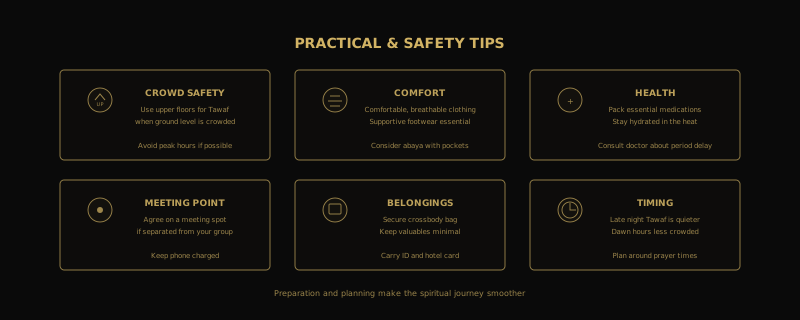
Pro tip: Roll your clothes to save space. Pack a “day bag” with essentials (water, snacks, medication, phone, ID, wipes) that you carry during the rites. Leave unnecessary valuables at home - you will be in massive crowds and theft does occur.
How can women stay safe during crowded rites?
The crowds at Hajj can be genuinely overwhelming, particularly during Tawaf, the pelting of the Jamarat, and the movement between Arafah, Muzdalifah, and Mina. Here are essential safety measures:
- Stay with your group. Agree on meeting points in case you get separated. Share your phone’s live location with your mahram or travel companion.
- Avoid peak times. Tawaf and pelting are less crowded late at night and in the early morning. Take advantage of the flexibility in timing.
- Use upper floors. The upper levels of Masjid al-Haram are significantly less crowded for Tawaf.
- Protect your body. In dense crowds, cross your arms over your chest to create space. If the crowd surges, move with it - do not fight against it.
- Keep identification on you at all times. Carry your passport copy, hotel card, and emergency contacts in a secure pouch under your clothing.
- Use the Tawakkalna or Nusuk apps for crowd management and real-time updates from Saudi authorities.
What about bathroom facilities?
Masjid al-Haram and the surrounding areas have public bathrooms, and they have been significantly upgraded in recent years. However, they can be crowded, the queues for the women’s section are often longer than for men, and cleanliness varies. The bathrooms in Mina (the tent city) are basic shared facilities. Bring your own tissue, wet wipes, a portable bidet bottle, and hand sanitiser. Use the bathroom before starting Tawaf or Sa’ee, as leaving mid-rite is disruptive. In Muzdalifah (where pilgrims spend the night under the open sky), facilities are extremely limited - prepare mentally and practically for this.
Practical tip: A small, refillable squeeze bottle (the kind marketed as a “travel bidet”) is one of the most valuable items you can pack. It ensures you can perform istinja properly even when bathroom facilities are basic. Many women consider this their most important Hajj packing item.
Can women use scented soap during Ihram?
No. While in the state of Ihram, both men and women must avoid using scented products, including perfumed soap, shampoo, body wash, and lotion. Use unscented alternatives instead. Most pharmacies in Makkah and Madinah sell unscented soap specifically marketed for pilgrims. If you accidentally use scented soap, wash it off and seek forgiveness - there is no penalty for genuine mistakes, but deliberate use of fragrance during Ihram may require a fidyah (compensation).
Tips for women doing Hajj while pregnant
Performing Hajj while pregnant is permissible, but it requires serious consideration and medical clearance. The physical demands of Hajj are enormous - long walks, extreme heat (often above 45°C), massive crowds, sleep deprivation, and limited medical facilities in some areas.
Medical advice: Consult your obstetrician before booking. Most doctors advise against travelling for Hajj during the first trimester (risk of miscarriage) and the third trimester (risk of premature labour). The second trimester is generally considered the safest window. Your doctor may advise against it entirely depending on your pregnancy’s health profile.
If you do go while pregnant: Stay hydrated at all times, rest frequently, use a wheelchair for Tawaf and Sa’ee if needed (this is permissible), wear compression socks, carry your medical records, know the location of the nearest hospital, and do not push yourself physically beyond your limits. Remember: Hajj is obligatory once in a lifetime - if this pregnancy makes it dangerous, you can delay until a safer time.
Can women cut their own hair after Umrah or Hajj?
Yes. A woman trims approximately a fingertip’s length (about 1–2 cm) from the ends of her hair. She may do this herself - she does not need someone else to cut it for her. She gathers her hair and trims from the tips. Women do NOT shave their heads - this is exclusively for men. The Prophet ﷺ said: “There is no shaving for women; rather women should shorten (their hair).” (Abu Dawud 1984).
Practical tip: Bring a small pair of scissors in your luggage (not hand luggage for the flight). After completing Umrah rites or Hajj rites, simply trim the ends of your hair. If your hair is layered, trim from the longest layer. Once you have trimmed, you have exited the state of Ihram and all restrictions are lifted.
What about breastfeeding during Hajj?
Breastfeeding during Hajj is permissible and many mothers do it. It does not affect your state of Ihram or the validity of any rite. You can breastfeed during Tawaf, Sa’ee, at Arafah, in Mina, or anywhere else. Islam encourages breastfeeding and there is no restriction on it during pilgrimage. The practical challenge is finding a private, comfortable spot in crowded conditions. Some areas of the Haram have women’s rest areas that offer more privacy. A breastfeeding cover or large scarf provides modesty in public spaces.
Practical tip: Stay well hydrated, as dehydration in the Saudi heat can reduce milk supply. If you are doing Hajj with a baby, consider bringing a sling or baby carrier rather than a pram, as the crowds make prams very difficult to manoeuvre. Bring any breast pump supplies you may need, as specific brands may not be available locally.
Women travelling alone - safety tips
For women travelling with a group but without close family, or those aged 45+ travelling in organised groups without a mahram, safety and comfort require extra planning:
- Choose a reputable Hajj operator with a track record and references from other women who have used them.
- Stay connected. Keep your phone charged at all times. Share your live location with a trusted person back home. Save emergency numbers for Saudi police (999), ambulance (997), and your embassy.
- Buddy system. Partner with another woman in your group for all movements, especially at night and in crowded areas.
- Keep valuables hidden. Use a flat money belt under your abaya. Do not carry large amounts of cash.
- Know your accommodation details. Memorise your hotel name and address (or keep a card in your pocket) in case you get lost.
- Trust your instincts. If a situation feels unsafe, remove yourself immediately. Do not hesitate to ask security personnel or police for help - they are stationed throughout the Haram and surrounding areas.
What about accommodation and privacy in Mina tents?
During the days of Hajj (10th–13th Dhul Hijjah), pilgrims stay in the tent city of Mina. The tents are gender-segregated - men and women sleep in separate sections or separate tents, depending on the Hajj operator’s arrangements. The quality of accommodation varies significantly based on your Hajj package. Standard packages offer shared tents with mattresses on the floor, while premium packages may offer smaller shared groups with better bedding and air conditioning.
Practical tips for Mina: Bring an eye mask and earplugs for sleeping (it is noisy 24 hours). Keep a small bag with your essentials close to you at all times. Use the bathroom in shifts with your group. Wear comfortable, loose clothing for sleeping. Shower facilities are basic and shared - quick showers and flip-flops are essential. If privacy is a major concern, discuss tent arrangements with your Hajj operator before booking.
7. Common Misconceptions
Some of the most damaging myths in our communities relate to women and worship. These misconceptions can cause women to feel excluded from their own religious obligations. Let us correct them clearly, with evidence.
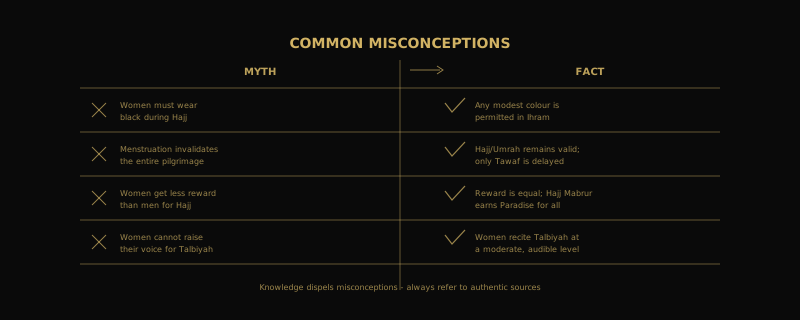
“Women can’t do Hajj during their period” - FALSE
This is perhaps the single most harmful misconception about women and Hajj. A menstruating woman CAN and SHOULD perform Hajj. She does everything - stands at Arafah, sleeps at Muzdalifah, pelts the Jamarat, makes dua, does dhikr, sacrifices - except Tawaf, which she delays until she is clean. The Prophet ﷺ explicitly told Aishah (RA): “Do everything that the pilgrim does, but do not perform Tawaf around the House until you are clean.” (Sahih al-Bukhari 305). If a woman’s period begins during Hajj, she does NOT go home, she does NOT abandon her Hajj, and she is NOT in any way deficient in her worship. She simply delays the Tawaf.
“Women must wear white for Ihram” - FALSE
There is no requirement for women to wear white during Ihram. This is a cultural practice that has been mistakenly elevated to a religious ruling. The white garments are prescribed for men only (the two unstitched sheets called the izar and rida’). Women wear their normal modest clothing in any colour. In fact, wearing very thin white fabric can sometimes be less modest than darker clothing, making dark colours a better practical choice for many women. Neither the Quran nor any hadith prescribes a specific colour for women’s Ihram clothing.
“Women can’t recite Quran during menstruation” - Scholarly difference
This is not a straightforward “true or false” - it is a legitimate area of scholarly difference. The classical position in the Hanafi, Maliki, and Shafi’i schools was that menstruating women should not recite Quran. However, many contemporary scholars - including Sheikh Ibn Taymiyyah, Sheikh Ibn Baz, and Sheikh Ibn Uthaymeen - have stated that there is no authentic, explicit prohibition on it. The hadith often cited (Tirmidhi 131) has been graded weak by numerous hadith scholars. The Hanbali madhab permits it if the woman fears forgetting what she has memorised. The practical position adopted by many scholars today is that a menstruating woman may recite Quran, especially from a phone or tablet (which avoids the issue of touching the mushaf), and this is particularly important during the blessed days of Hajj so women are not deprived of this worship.
“Women’s Hajj is less rewarded than men’s” - FALSE
This is completely and categorically false. There is no evidence whatsoever that a woman’s Hajj is less rewarded than a man’s. In fact, the Prophet ﷺ described Hajj as the jihad of women, elevating it to the highest level of deed:
Aishah (RA) asked: “O Messenger of Allah, do women have to engage in jihad?” He ﷺ said: “Yes, upon them is a jihad in which there is no fighting: Hajj and Umrah.”
- Ibn Majah 2901And the Prophet ﷺ also said: “An accepted Hajj has no reward except Paradise.” (Sahih al-Bukhari 1773). This promise is for every pilgrim - male and female. A woman’s Hajj, performed sincerely and correctly, earns the same immense reward as a man’s.
“Women should stay at the back during Tawaf” - Recommended, not obligatory
It is recommended (mustahabb), not obligatory, for women to perform Tawaf at a slight distance from the Ka’bah to avoid being crushed in the crowds that gather near the Black Stone and the Multazam. Aishah (RA) used to do Tawaf at a distance from the men, not mixing with them (Sahih al-Bukhari 1618). However, this is a recommendation for safety and comfort, not a binding obligation. If a woman wishes to be near the Ka’bah, her Tawaf is completely valid. Many women find that during less crowded times (late night, early morning), they can comfortably do Tawaf closer to the Ka’bah without being jostled.
“Women should not raise their hands in dua” - FALSE
Women, like men, are encouraged to raise their hands when making dua. The Prophet ﷺ said: “Your Lord is Generous and Shy. If His servant raises his hands to Him, He is shy to return them empty.” (Abu Dawud 1488, Tirmidhi 3556). There is no prohibition on women raising their hands in supplication during Hajj, Umrah, or at any other time. Whether at Arafah, between Safa and Marwah, at the Multazam, or in your hotel room - raise your hands, open your heart, and ask Allah for everything you need.