Nusuk app adds new features and offline access for pilgrims
Saudi Arabia's official Nusuk app has added spiritual, navigation and health tools plus a zero-data offline mode, and no...
The Radiant City of the Prophet ﷺ - virtues, etiquettes, and a complete guide to visiting
Madinah. Al-Madinah al-Munawwarah - the Radiant City. Also known as Taybah and Tabah, both meaning “the good and pure.” This is the city that opened its arms to the Prophet (SAW) when Makkah cast him out. The city whose people - the Ansar - gave everything they had to shelter the faith. The city where Islam was built, where the Muslim ummah was forged, where the Quran was completed, and where the Prophet (SAW) lived, taught, governed, and was laid to rest.
Visiting Madinah is not a rite of Hajj or Umrah. It is not wajib (obligatory) and it is not a condition for the validity of your pilgrimage. However, it is highly recommended and an immense blessing. The vast majority of pilgrims visit Madinah either before or after their Hajj, and it is one of the most spiritually enriching experiences a Muslim can have.
The Prophet (SAW) said: “Do not set out on a journey except to three mosques: Al-Masjid al-Haram, this mosque of mine, and Al-Masjid al-Aqsa.”
Sahih al-Bukhari 1189, Sahih Muslim 1397This hadith establishes that the Prophet’s Mosque in Madinah is one of only three mosques in the entire world for which a special journey is legislated. You are not merely visiting a city - you are answering a prophetic invitation to pray in one of the most blessed places on earth.
When to Visit: Most pilgrims visit Madinah either before Hajj (arriving in Madinah first, spending several days, then travelling to Makkah for Hajj) or after Hajj (completing all Hajj rites, then travelling to Madinah before returning home). There is no prescribed order - both are perfectly valid. Many Hajj packages include a stay in Madinah as part of the itinerary. A stay of eight days is common, allowing you to pray forty consecutive prayers in the Prophet’s Mosque - though this specific virtue is based on a hadith whose authenticity is discussed among scholars (narrated in Musnad Ahmad 12173).
You are about to walk the streets the Prophet (SAW) walked. You will pray where he prayed. You will stand at his grave. You will breathe the air of the city he loved more than any other place on earth. This city embraced him when Makkah rejected him. Its people gave him shelter when his own tribe plotted to murder him. It is called “Radiant” because his light still fills it. When he first arrived, the narrations say Madinah literally shone with his presence. Enter this city with love. Enter with reverence. Enter knowing that you are a guest in the city of your Prophet, the best human being who ever lived, the one who will intercede for you on the Day of Judgement. Walk softly. Speak gently. And let your heart break with the honour of being here.
The Prophet (SAW) spoke of Madinah’s virtues extensively. He loved this city deeply, made dua for it repeatedly, and declared it a sacred sanctuary - just as Ibrahim (AS) had declared Makkah a sanctuary. The ahadith about Madinah’s virtues are numerous and well-established:
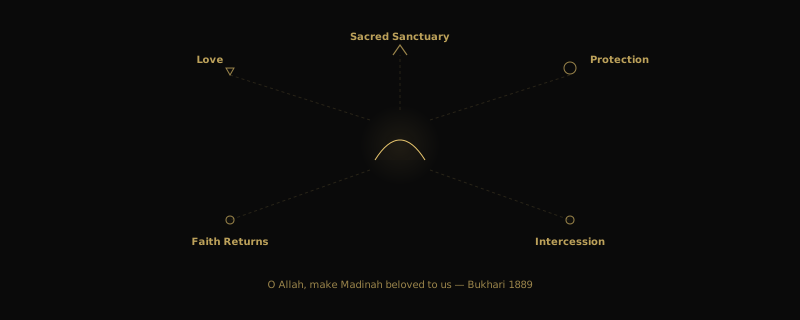
The Prophet (SAW) said: “O Allah, make us love Madinah as we love Makkah, or even more.”
Sahih al-Bukhari 1889When he would return from a journey and see the walls and buildings of Madinah, he would hasten his riding animal out of his deep love for the city. If he was on his mount, he would make it go faster. His heart raced for Madinah the way our hearts race for our homes - except that his love was purer, deeper, and sanctified by revelation.
The Prophet (SAW) said: “Madinah is a sanctuary from that place to that place. Its trees should not be cut and no heresy should be innovated nor any sin committed in it.”
Sahih al-Bukhari 1867The Prophet (SAW) said: “O Allah, Ibrahim made Makkah sacred, and I make Madinah sacred - what is between its two lava fields - that its trees not be cut and its game not be hunted. O Allah, bless us in our Sa’ and our Mudd (measures of Madinah).”
Sahih Muslim 1373Just as Makkah was declared a sanctuary by Ibrahim (AS), the Prophet (SAW) declared Madinah sacred territory. The area between its two harrah (lava fields) - Harrat Waqim to the east and Harrat al-Wabarah to the west - is sanctified ground. Its trees may not be cut down and its wild animals may not be hunted. This is a divinely-sanctioned sanctity.
The Prophet (SAW) said: “There are angels guarding the entrances of Madinah; neither plague nor the Dajjal will be able to enter it.”
Sahih al-Bukhari 1880Madinah is guarded by angels. No plague will strike it. The Dajjal - the greatest tribulation to face humanity - will not be able to enter it. When he approaches Madinah in the end times, the earth will shake three times and every munafiq (hypocrite) will leave, while the believers will remain protected within its blessed boundaries.
The Prophet (SAW) said: “Indeed, faith (iman) returns to Madinah as a snake returns to its hole.”
Sahih al-Bukhari 1876, Sahih Muslim 147Just as a snake always returns to its home, faith will always return to Madinah. No matter how far it spreads across the world, its root and its refuge will always be this blessed city. Scholars have interpreted this to mean that in times of tribulation and confusion, Madinah will remain a stronghold of authentic faith and Sunnah.
The Prophet (SAW) said: “Whoever is able to die in Madinah, let him die there, for I will intercede for the one who dies there.”
Jami’ al-Tirmidhi 3917 (graded Hasan)The Prophet (SAW) specifically promised his intercession for those who die in Madinah. This is why, throughout history, scholars and righteous people have sought to live and die in this city. Umar (RA) himself used to make dua: “O Allah, grant me martyrdom in Your cause and let me die in the city of Your Prophet.” (Sahih al-Bukhari 1890). And Allah answered his dua.
The Prophet (SAW) said: “Whoever endures the hardship and difficulty of Madinah, I will be an intercessor or witness for him on the Day of Judgement.”
Sahih Muslim 1377Madinah, historically, was a land of fever and harsh conditions. The early Muhajiroon (emigrants) suffered greatly from its climate. Yet the Prophet (SAW) promised that whoever bears Madinah’s hardships with patience will have the Prophet himself as an intercessor on the Day of Judgement. Even today, the heat of Madinah in summer is severe - bear it with patience and remember this promise.
The Prophet (SAW) said: “Madinah is like a furnace - it expels its impurities and its goodness shines.”
Sahih al-Bukhari 1883, Sahih Muslim 1383Just as a furnace purifies gold by burning away impurities, Madinah purifies those who live in it. The hypocrites could not endure Madinah - they were exposed and expelled. The sincere believers remained and were strengthened. This city has a spiritual filtration system built into its very soil.
Consider the weight of these narrations together. This is a city guarded by angels. Protected from the Dajjal. Declared a sanctuary by the lips of the Prophet (SAW) himself. A city where faith always returns. Where dying earns intercession. Where hardship earns witness. Where impurity is expelled and goodness shines. You are not visiting an ordinary place. You are entering sacred ground - ground that has been prayed over, wept over, fought for, and blessed by the best generation of human beings who ever lived. Walk this ground with the reverence it deserves.
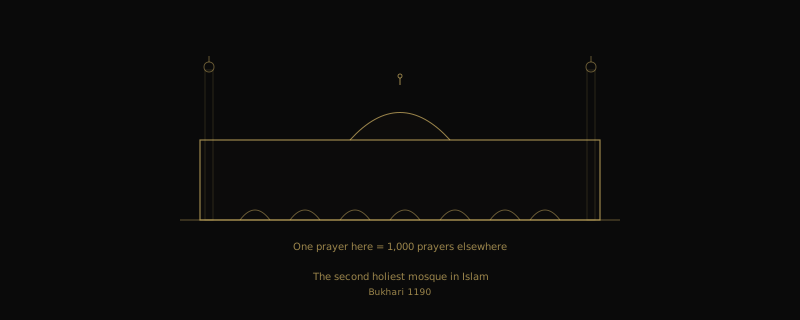
The Prophet (SAW) said: “One prayer in this mosque of mine is better than one thousand prayers offered anywhere else, except al-Masjid al-Haram.”
Sahih al-Bukhari 1190, Sahih Muslim 1394One prayer in the Prophet’s Mosque is worth one thousand prayers elsewhere. That means a single Fajr prayer here is equivalent to roughly 2.7 years of Fajr prayers prayed at home. Every moment you spend praying in this mosque is multiplied beyond measure. Maximise your prayers here.
When the Prophet (SAW) arrived in Madinah during the Hijrah (migration from Makkah), the very first thing he did was establish a mosque. His she-camel, Qaswa, knelt at a spot that belonged to two orphans from the Ansar. The Prophet (SAW) purchased the land and began building the mosque with his own hands. He carried bricks. He laid foundations. He mixed mortar. The Companions worked alongside him, and they composed poetry as they laboured:
“O Allah, there is no good except the good of the Hereafter, so forgive the Ansar and the Muhajiroon.”
The original mosque was humble beyond imagination. Its walls were made of unbaked bricks and mud. Its roof was of palm leaves and branches. Its pillars were palm tree trunks. The floor was bare earth, and when it rained, the ground turned to mud and the worshippers prostrated in it. There was no carpet, no marble, no air conditioning - just sincerity, and the presence of the greatest human being who ever lived.
Over the centuries, the mosque has been expanded numerous times:
| Period | Expansion |
|---|---|
| Umar ibn al-Khattab (RA) - 17 AH | First major expansion; added land to the north and west |
| Uthman ibn Affan (RA) - 29 AH | Replaced mud walls with carved stone; replaced wooden columns with stone |
| Umayyad Era - al-Walid ibn Abd al-Malik, 88 AH | Major expansion; the Prophet’s chambers were incorporated into the mosque |
| Abbasid Era | Further expansions under various Abbasid caliphs |
| Mamluk Era | The famous dome over the Prophet’s grave was first built (originally white/unpainted) |
| Ottoman Era | Major renovations; the dome was painted green (as it remains today) |
| Saudi Era - 1950s and 1990s | Massive expansions under King Abdulaziz and King Fahd; capacity increased to over 1 million worshippers; retractable roof, marble courtyards, the iconic umbrella structures |
The famous green dome - arguably the most recognisable symbol of Madinah - was built by the Mamluks in 1279 CE and was originally white. It was later painted various colours before being painted its distinctive green by the Ottomans in 1837 CE. It marks the location of the Prophet’s burial chamber beneath it.
Today, the Prophet’s Mosque is one of the largest mosques in the world. Its current capacity exceeds one million worshippers when the courtyards and rooftop are included. The iconic retractable umbrellas on the plaza open during the day to provide shade and are one of the most beautiful sights in the Islamic world.
Practical Tip: The Prophet’s Mosque is open 24 hours. The best times for quieter worship are after Isha and in the late night/early morning hours before Fajr. Take advantage of these quieter times for longer prayers and reflection. Bring a light jacket - the air conditioning inside can be quite cold.
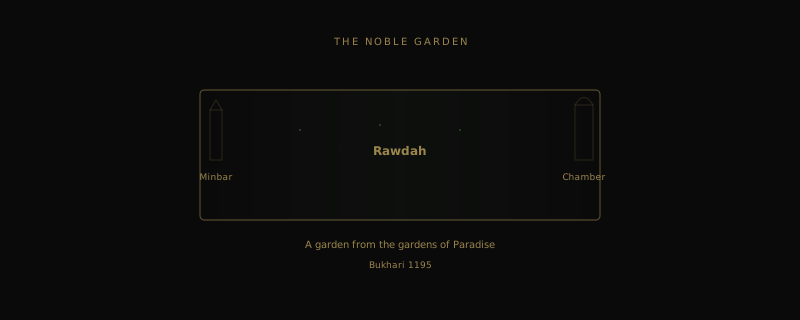
The Prophet (SAW) said: “Between my house and my pulpit is a garden (rawdah) from the gardens of Paradise.”
Sahih al-Bukhari 1195, Sahih Muslim 1390The Rawdah is the area located between the Prophet’s chamber (the room where he is buried, which was originally the room of Aisha, may Allah be pleased with her) and the original location of his pulpit (minbar). This is not a metaphor. The Prophet (SAW) said it is literally a garden of Paradise. A piece of Jannah on this earth.
You can identify the Rawdah by its distinctive green carpet, while the rest of the mosque has red carpet. The area is approximately 22 metres long by 15 metres wide - a relatively small space for the millions who wish to pray in it.
Practical Tip: The Rawdah is extremely crowded during peak times. Specific time slots are often allocated, and access may be controlled by mosque staff. For the best chance of access:
You are standing in a garden of Paradise. Not metaphorically - the Prophet (SAW) said it with his own blessed lips. Every prostration here touches the soil of Jannah. Every tear that falls here waters a garden that will bloom for you in the Hereafter. Pray with that awareness. Weep with that knowledge. Let the enormity of where you are wash over you. Millions of Muslims have lived and died dreaming of standing where you are standing right now. You may never stand here again. Make this prayer count as though it is the last prayer you will ever offer.
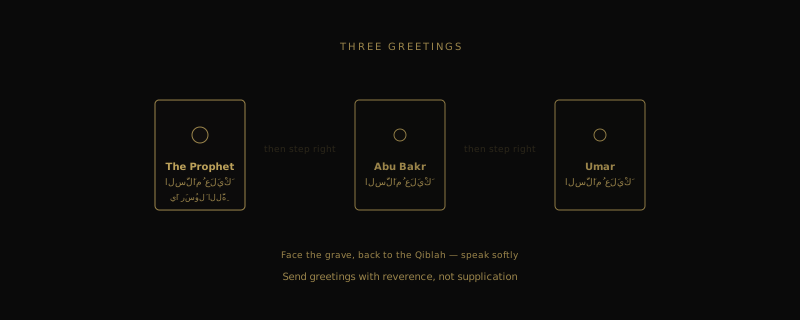
It is from the Sunnah to visit the grave of the Prophet (SAW) and give him salaam. The Prophet (SAW) is buried in what was the room of Aisha (RA), and beside him lie his two closest companions: Abu Bakr as-Siddiq (RA) and Umar ibn al-Khattab (RA). This room is enclosed within the mosque, behind brass screens and walls.
The Prophet (SAW) said:
“No one sends salaam upon me except that Allah returns my soul to me so that I may return his salaam.”
Sunan Abi Dawud 2041 (graded Hasan by al-Nawawi)السَّلَامُ عَلَيْكَ يَا رَسُولَ اللَّهِ، السَّلَامُ عَلَيْكَ يَا نَبِيَّ اللَّهِ
As-salamu ‘alayka ya Rasulallah, as-salamu ‘alayka ya Nabiyyallah
“Peace be upon you, O Messenger of Allah. Peace be upon you, O Prophet of Allah.”
You may also add: “As-salamu ‘alayka ya khayr khalqillah. Ash-hadu annaka qad ballaght ar-risalah, wa addayt al-amanah, wa nasaht al-ummah, wa jahadta fillahi haqqa jihadih.” (Peace be upon you, O best of Allah’s creation. I bear witness that you conveyed the message, fulfilled the trust, advised the ummah, and strove in the way of Allah a true striving.)
السَّلَامُ عَلَيْكَ يَا أَبَا بَكْرٍ، خَلِيفَةَ رَسُولِ اللَّهِ
As-salamu ‘alayka ya Aba Bakr, khalifata Rasulillah
“Peace be upon you, O Abu Bakr, successor of the Messenger of Allah.”
You may add: “Jazak Allahu ‘an ummat Muhammad khayra.” (May Allah reward you on behalf of the ummah of Muhammad with good.)
السَّلَامُ عَلَيْكَ يَا عُمَرُ، أَمِيرَ الْمُؤْمِنِينَ
As-salamu ‘alayka ya ‘Umar, Amir al-Mu’mineen
“Peace be upon you, O Umar, Commander of the Faithful.”
You may add: “Jazak Allahu ‘an ummat Muhammad khayra.” (May Allah reward you on behalf of the ummah of Muhammad with good.)
Critical Aqeedah Point: Do NOT make dua to the Prophet (SAW). Do not ask him for intercession, forgiveness, help, or anything else. Do not supplicate to him, call upon him, or direct any form of worship towards him. All dua is directed to Allah alone. The Prophet (SAW) himself explicitly warned against this:
“Do not make my grave a place of festivity (a place of repeated celebration like an ‘eid).” - Sunan Abi Dawud 2042
“Do not make my grave an idol that is worshipped.” - Musnad Ahmad 7352
“O Allah, do not let my grave become an idol that is worshipped. The anger of Allah intensified against a people who took the graves of their prophets as places of worship.” - Muwatta Malik 416
Visit the Prophet’s grave with love. Give salaam. Send blessings upon him. But direct all requests, all supplications, all worship to Allah. This is the aqeedah of Ahl al-Sunnah wal Jama’ah. This is what the Prophet (SAW) himself taught and commanded.
After giving salaam to the Prophet (SAW), you may step back, face the Qiblah, and make dua to Allah. Some scholars - including Imam al-Nawawi, Ibn Qudamah, and others - consider it permissible to make tawassul through the Prophet’s status, meaning you ask Allah by the rank and status He has given the Prophet: “O Allah, I ask You by the rank of Your Prophet…” This is distinct from asking the Prophet himself - you are asking Allah, mentioning the Prophet as a means. Other scholars, including Ibn Taymiyyah and Ibn al-Qayyim, held that this specific form of tawassul is not established from the Companions and is therefore not recommended. There is legitimate scholarly difference on this point among Ahl al-Sunnah. The safest and agreed-upon position is to make dua to Allah directly, using His names and attributes, mentioning your own good deeds, and asking with sincerity and humility.
Practical Tip: The passage past the Prophet’s grave can be very crowded and flows quickly. Guards may keep the line moving. Do not expect to stand still for a long time. Prepare your salaam in advance. Say it clearly but briefly. If you are pushed along quickly, do not worry - your salaam has been heard. You may also send salaam upon the Prophet (SAW) from anywhere in the mosque, or indeed from anywhere in the world - “Send salaam upon me, for your salaam reaches me wherever you are” (Abu Dawud 2042).
You are standing at the grave of Muhammad ibn Abdullah (SAW). The Seal of the Prophets. The one who was sent as a mercy to all the worlds. The man who wept for you before you were born, saying: “My ummah, my ummah.” The one who will stand at the Hawd (basin) on the Day of Judgement waiting for you. The one who will prostrate before Allah and beg for your forgiveness when no one else will. You love him. He loved you more. Send your salaam with a full heart. And when you walk away, walk away determined to live by his Sunnah - because that is the truest expression of love.
Masjid Quba holds a unique honour in Islamic history: it is the first mosque ever built in Islam. When the Prophet (SAW) made his Hijrah from Makkah to Madinah, he stopped first at the village of Quba, on the outskirts of Madinah. He stayed there for several days before continuing to Madinah proper, and during those days, he established this mosque - laying its very first stones with his own blessed hands.
Allah Himself mentioned this mosque in the Quran:
“A mosque founded on righteousness from the first day is more worthy for you to stand in. In it are men who love to purify themselves, and Allah loves those who purify themselves.”
Quran 9:108And the Prophet (SAW) attached an enormous reward to visiting it:
The Prophet (SAW) said: “Whoever purifies himself in his house, then comes to Masjid Quba and prays in it, he will have a reward like that of Umrah.”
Sunan Ibn Majah 1412, Sunan al-Nasai 699Read that again. A prayer in Masjid Quba - after making wudu at your accommodation - earns you the reward of an entire Umrah. This is one of the easiest and most rewarding acts of worship available to you in Madinah.
The Prophet (SAW) used to visit Masjid Quba every Saturday, sometimes walking and sometimes riding.
Sahih al-Bukhari 1191, Sahih Muslim 1399Practical Tips for Visiting Quba:
This simple mosque was the first house of worship built in the era of Prophet Muhammad (SAW). Before the grand mosques with their marble and gold, before the expansions that house millions, before the domes and minarets that define skylines - there was Quba. A humble structure built on sincerity and taqwa. Allah did not praise it for its architecture. He praised it because it was “founded on righteousness from the first day.” The lesson for us: it is not the grandeur of our worship that matters, but its foundation. A prayer offered in a mud-brick mosque with sincerity outweighs a prayer offered in a marble palace with arrogance. Sincerity, not splendour, is what makes a place - and a person - sacred.
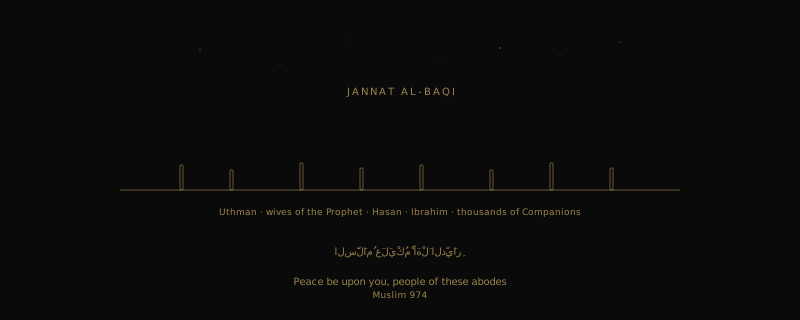
Jannat al-Baqi - literally “the Garden of al-Baqi” - is the main cemetery of Madinah, located immediately adjacent to the southeastern wall of the Prophet’s Mosque. It is the most blessed graveyard on earth after the graves of the Prophets. Thousands upon thousands of Companions (Sahabah), members of the Prophet’s household, scholars, and righteous Muslims are buried here.
Among the luminaries of Islam buried here are:
The Prophet (SAW) used to visit al-Baqi at night. Aisha (RA) narrated that he would go out in the latter part of the night and say:
السَّلَامُ عَلَيْكُمْ أَهْلَ الدِّيَارِ مِنَ الْمُؤْمِنِينَ وَالْمُسْلِمِينَ، وَإِنَّا إِنْ شَاءَ اللَّهُ بِكُمْ لَاحِقُونَ، نَسْأَلُ اللَّهَ لَنَا وَلَكُمُ الْعَافِيَةَ
As-salamu ‘alaikum ahl ad-diyar min al-mu’mineen wal-muslimeen, wa inna in sha Allahu bikum lahiqun, nas’al Allaha lana wa lakum al-‘afiyah
“Peace be upon you, O inhabitants of this abode, from among the believers and Muslims. We will, Allah willing, join you. We ask Allah for well-being for us and for you.”
- Sahih Muslim 974
He also used to say:
اللَّهُمَّ اغْفِرْ لِأَهْلِ بَقِيعِ الْغَرْقَدِ
Allahumma ighfir li ahli Baqi al-Gharqad
“O Allah, forgive the people of Baqi al-Gharqad.”
- Sahih Muslim 974
Important: Do NOT make dua to the dead, ask them for help, seek their intercession directly, or engage in any form of grave-worship. This is shirk (associating partners with Allah) and is the very thing the Prophet (SAW) warned against most severely. Visit al-Baqi to give salaam, to make dua for them (asking Allah to forgive them), and to reflect on your own mortality. That is all.
Practical Tips:
Standing at al-Baqi, you are standing above the remains of people who saw the Prophet (SAW) with their own eyes. Who heard his voice. Who prayed behind him. Who fought beside him. Who gave everything - their homes, their wealth, their families, their lives - for this religion. They are now beneath the soil, waiting for the Day when Allah will raise them. And one day, sooner than you think, you will be beneath the soil too. The Prophet (SAW) said: “Visit the graves, for they remind you of the Hereafter” (Muslim 976). Let al-Baqi do what it was meant to do - let it shatter your illusion of permanence. You are temporary. Act accordingly.
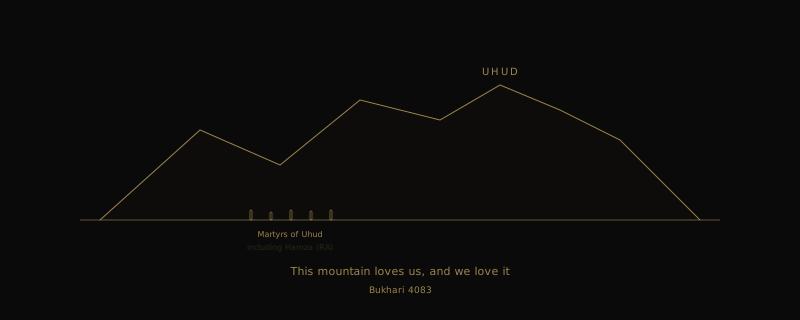
The Prophet (SAW) said: “Uhud is a mountain that loves us and we love it.”
Sahih al-Bukhari 1481, Sahih Muslim 1365Mount Uhud lies to the north of Madinah, a rugged, reddish mountain that stretches across the horizon. The Prophet (SAW) expressed love for this mountain, and the mountain loves him back. This is not poetic language - the Prophet (SAW) stated it as fact. The rocks and mountains of this earth submit to Allah and recognise His Prophet.
In the third year after the Hijrah (625 CE), the Quraysh of Makkah marched against Madinah with an army of 3,000, seeking revenge for their defeat at Badr. The Prophet (SAW) met them at the foot of Mount Uhud with around 700 men.
The battle began well for the Muslims, but a critical error changed its course. The Prophet (SAW) had placed fifty archers on a small hill (known today as Jabal al-Rumah, the Mount of the Archers) with strict orders: “Do not leave this position, even if you see birds snatching at us.” But when the Muslim infantry appeared to be winning, most of the archers left their post to collect spoils. The Makkan cavalry, led by Khalid ibn al-Walid (who had not yet accepted Islam), swept around the unguarded flank and attacked from behind.
The result was devastating. Seventy Companions were martyred. Among them was Hamzah ibn Abd al-Muttalib (RA), the Prophet’s beloved uncle, the “Lion of Allah,” who was killed by Wahshi ibn Harb and then mutilated by Hind bint Utbah.
The Prophet (SAW) himself was seriously wounded. His blessed face was cut. His tooth was broken. He fell into a ditch. A rumour spread that he had been killed, which caused chaos among the ranks. Yet he stood firm, rallied his Companions, and the Muslims regrouped.
The Prophet (SAW) said about the martyrs of Uhud: “I am a witness for these people.”
Sahih al-Bukhari 1344At the foot of Mount Uhud lies the Martyrs’ Cemetery, where the seventy Companions who fell in the battle are buried. The Prophet (SAW) visited them regularly and made dua for them. When you visit, give them salaam and make dua for them.
The Prophet (SAW) said over the martyrs of Uhud:
سَلَامٌ عَلَيْكُمْ بِمَا صَبَرْتُمْ ۚ فَنِعْمَ عُقْبَى الدَّارِ
Salamun ‘alaykum bi ma sabartum, fa ni‘ma ‘uqba ad-dar.
“Peace be upon you for what you patiently endured. Excellent indeed is the final home.” (Quran 13:24)
Be Cautious: There are people at Uhud who sell souvenirs and try to guide tourists, sometimes promoting innovated practices or fabricated stories. Be wary of anyone claiming to show you the “exact spot” of specific events or encouraging you to do things not established in the Sunnah. Simply visit, give salaam to the martyrs, reflect on the sacrifice of the Companions, and leave. Do not rub the walls, collect soil as “blessed relics,” or engage in any practice that has no basis in the Quran and Sunnah.
Practical Tip: Mount Uhud is about 5 km north of the Prophet’s Mosque. Most Hajj/Umrah groups include a visit to Uhud in their itinerary. If travelling independently, a taxi or ride-share is the easiest option. The site is open and there is no entrance fee. You can also see Jabal al-Rumah (the Archers’ Hill) nearby - it is a small mound where the archers were stationed.
Uhud teaches us something that Badr did not: that obedience to the Prophet (SAW) is not optional, and that victory comes from discipline, not desire. The archers had clear instructions. They chose their own judgement over the Prophet’s command. The consequences were catastrophic. How often do we do the same? How often do we know the Sunnah, know the ruling, know what Allah and His Messenger have commanded - and choose our own preference instead? Uhud is a mirror. Look into it honestly. And standing at the graves of those seventy men who gave their lives, ask yourself: would you have stayed on that hill? Would you have obeyed when everyone else was running? That is the real question of Uhud. Not what happened then - but what you would do now.
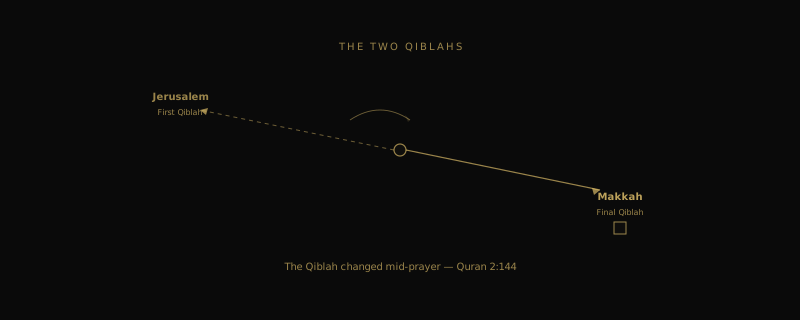
Masjid al-Qiblatayn holds a singular place in Islamic history. It is the mosque where, during a congregational prayer, the command to change the direction of prayer from Jerusalem to Makkah was received.
For approximately sixteen or seventeen months after the Hijrah, the Muslims prayed facing Bayt al-Maqdis (Jerusalem). The Prophet (SAW) longed to face the Ka’bah instead, and he would look up to the sky, hoping for a revelation. Allah responded:
“We have certainly seen the turning of your face toward the heaven, and We will surely turn you to a qiblah with which you will be pleased. So turn your face toward al-Masjid al-Haram. And wherever you are, turn your faces toward it.”
Quran 2:144According to narrations, this command came while a prayer was already in progress. The imam turned mid-prayer from facing Jerusalem to facing Makkah, and the entire congregation followed. It was an extraordinary moment - an act of immediate obedience to divine command, without hesitation, without debate, without delay. Mid-prostration, they shifted. This is what submission to Allah looks like.
The change of Qiblah was also a test. Allah says in the next verse:
“And We did not make the qiblah which you used to face except that We might make evident who would follow the Messenger from who would turn back on his heels.”
Quran 2:143The hypocrites and doubters criticised the change. The sincere believers accepted it instantly. The Qiblah was a test of loyalty - do you follow Allah, or do you follow your own logic?
Practical Tip: Masjid al-Qiblatayn is located in the northwestern part of Madinah, about 4 km from the Prophet’s Mosque. It has been renovated and is a beautiful white mosque. It is a quick taxi ride and well worth visiting for its immense historical significance. You can pray there and reflect on the momentous event that took place within its walls.
Located near the Prophet’s Mosque, Masjid al-Ghamama is reported to be the site where the Prophet (SAW) prayed the Eid prayers and the Istisqa (rain prayer). The name “Ghamama” means “cloud,” referring to the narration that clouds gathered and rain fell when the Prophet (SAW) prayed for rain here. It is one of the oldest mosques in Madinah.
A cluster of small mosques located near the site of the Battle of the Trench (Khandaq), which took place in 5 AH when the Quraysh and their allies besieged Madinah. The Muslims, on the advice of Salman al-Farisi (RA), dug a trench to protect the city. These mosques are associated with locations where the Prophet (SAW) and some of his Companions prayed during the siege. The main one is Masjid al-Fath (the Mosque of Victory), where the Prophet (SAW) is reported to have made dua for three days until Allah granted the Muslims victory.
A small mountain near the site of the Battle of the Trench. It is associated with various events during the siege. Some narrations place the Prophet’s command post here during the battle. The area gives a sense of the terrain and geography that shaped early Islamic history.
A valley on the western outskirts of Madinah. It is mentioned in hadith as a blessed valley. The Prophet (SAW) said, referring to a prayer at Dhul Hulayfah (the miqat point near Madinah, also in this valley): “A caller came to me tonight from my Lord and said: Pray in this blessed valley.” (Sahih al-Bukhari 1534).
This is the miqat (point of entering ihram) for those travelling from Madinah to Makkah for Hajj or Umrah. If you are visiting Madinah before your Hajj or Umrah, this is where you will enter your state of ihram. It is the farthest miqat from Makkah, approximately 450 km away, which is why the Prophet (SAW) said: “The people of Madinah should enter ihram from Dhul Hulayfah” (Bukhari 1526).
A Word of Caution on “Historical Sites”: Many tour operators and locals will point out various “historical sites” in Madinah - the house of Abu Bakr, the spot where such-and-such event occurred, and so on. Many of these attributions are not authentically established. Stick to the well-known, verified locations: the Prophet’s Mosque, the Rawdah, Masjid Quba, al-Baqi, Mount Uhud, and Masjid al-Qiblatayn. These are the main sites with clear evidence. Be cautious about claims regarding other locations, and do not engage in any innovated practices at any site.
Madinah is a city built around the Prophet’s Mosque. Your entire visit will revolve around the mosque, and everything you need is within easy reach. Here is practical guidance to help you make the most of your time:
The massive courtyard (plaza) surrounding the Prophet’s Mosque features the iconic retractable umbrellas that open during the day to provide shade. Watching them open at sunrise is a beautiful experience. The courtyard has smooth marble flooring that can become extremely hot during the day in summer - wear footwear when walking on it during peak heat.
Madinah is world-famous for its dates, and the most prized variety is the Ajwa date - a dark, soft, sweet date that the Prophet (SAW) specifically recommended:
The Prophet (SAW) said: “Whoever eats seven Ajwa dates in the morning will not be harmed by poison or magic that day.”
Sahih al-Bukhari 5445Ajwa dates are more expensive than other varieties due to their special status, but they make an excellent purchase for yourself and as gifts. Other excellent Madinah date varieties include Safawi, Mabroom, Sukkari, and Khudri. Date shops are everywhere around the mosque - many allow you to taste before buying.
Buying Dates: Purchase from reputable shops. Prices vary significantly - compare a few shops before committing to a large purchase. Ajwa dates from the ‘Aliyah (high ground) area of Madinah are considered the most authentic and are what is referenced in the hadith. Ask for “Ajwa al-Madinah” specifically.
Remember: Your time in Madinah is limited. Every moment spent in idle chat, shopping unnecessarily, or scrolling on your phone is a moment that could have been spent earning the reward of a thousand prayers. Plan your worship. Set goals. And when you leave, leave knowing that you gave this blessed city everything you had.
Your journey is drawing to a close. Whether you visited Madinah before your Hajj or after it, whether this was your first pilgrimage or your tenth, the experience of standing in the city of the Prophet (SAW), praying in his mosque, giving salaam at his grave, and walking the streets where Islam was built - this is something that will stay with you for the rest of your life.
May Allah accept your Hajj and Umrah. May He forgive every sin you have ever committed - the ones you remember and the ones you have forgotten, the ones you did knowingly and the ones you did in ignorance. May He grant you Jannah al-Firdaws, the highest level of Paradise, without reckoning and without punishment. May He allow you to drink from the Hawd of the Prophet (SAW) on the Day of Judgement, a drink after which you will never thirst again. May He reunite you with the Prophet (SAW), with Abu Bakr, with Umar, with Uthman, with Ali, with the Companions, with the scholars, with the martyrs, and with all those you love for His sake. May you return home transformed. May you return pure. May the person who steps off the plane be fundamentally different from the person who boarded it.
رَبَّنَا تَقَبَّلْ مِنَّا ۖ إِنَّكَ أَنتَ السَّمِيعُ الْعَلِيمُ
Rabbana taqabbal minna innaka antas-Samee’ul-‘Aleem
“Our Lord! Accept from us. You are the All-Hearing, All-Knowing.” (Quran 2:127)
This is the dua of Ibrahim (AS) and Ismail (AS) as they built the Ka’bah. Even after completing the greatest act of worship, they were not certain of its acceptance. They begged. They implored. If Khalilullah himself was not sure his deeds would be accepted, how much more should we beg?
رَبَّنَا آتِنَا فِي الدُّنْيَا حَسَنَةً وَفِي الْآخِرَةِ حَسَنَةً وَقِنَا عَذَابَ النَّارِ
Rabbana atina fid-dunya hasanatan wa fil-akhirati hasanatan wa qina ‘adhab an-nar
“Our Lord, give us good in this world and good in the Hereafter, and save us from the punishment of the Fire.” (Quran 2:201)
This was the most frequent dua of the Prophet (SAW) himself. Anas (RA) said: “The most frequent supplication of the Prophet (SAW) was: Rabbana atina fid-dunya hasanatan wa fil-akhirati hasanatan wa qina ‘adhab an-nar.” (Sahih al-Bukhari 6389). If this dua was enough for the best of creation, it is certainly enough for us.
The Prophet (SAW) said: “Whoever performs Hajj and does not commit any obscenity or transgression shall return free of sin as on the day his mother bore him.”
Sahih al-Bukhari 1521As on the day your mother bore you. Clean. Pure. Without a single sin on your record. The weight of a lifetime of mistakes, errors, and transgressions - wiped clean. This is the promise of your Prophet (SAW). This is the mercy of your Lord. You came to Hajj carrying the burden of your sins. You leave carrying nothing but hope.
You came to these lands as a guest of Allah. You walked where Prophets walked. You prayed where angels pray. You stood where humanity will stand on the Last Day. You circled the House that Ibrahim built. You ran the path that Hajra ran. You stood on Arafah, the mountain of mercy, and you begged the Lord of the Worlds for His forgiveness. You slept under the stars in Muzdalifah. You pelted the Shaytan as Ibrahim pelted him. You sacrificed as Ibrahim was willing to sacrifice. You shaved your head in humility. You gave salaam to the greatest human being who ever lived.
Whatever happens next in your life, you have been to Hajj. You answered Ibrahim’s call - the call he made thousands of years ago, standing on a barren hill, calling out to the emptiness, trusting that Allah would make his voice reach every corner of the earth. His voice reached you. And you answered. Labbayk Allahumma labbayk.
You stood on Arafah. You were forgiven. Now go home and live like it. Be the person Allah saw on Arafah - the one with tears on their cheeks, hands raised to the sky, begging for mercy. Be that person every single day. Not just on Arafah. Not just in Ramadan. Not just when tragedy strikes. Every single day.
That is the real Hajj. Not the rituals - the transformation. Not the journey to Makkah - the journey to Allah. The planes will take you home. The question is: will you take the Hajj home with you?
May Allah make it so. Ameen.
Thank you for taking the time to use this resource. It has been a labour of love, and I pray it serves you well on your journey.
When I performed my first Hajj in 2008, it was a huge transformation for me. At that time, my wife and I had been trying to have children for some years. Despite the difficulty, I held a strong belief that my duas on the plain of Arafah would not go unanswered.
Lo and behold, shortly after our return, my wife did become pregnant - and we were blessed with twins, whom I named Safa and Marwah as a mark of gratitude and a lasting connection to those sacred places where Hajra (may Allah be pleased with her) ran in faith and desperation, and where Allah answered.
Hajj should be a pivot in your life. A transformation. A before and after. From that point on, you should see the world through a much deeper and more divine lens. The crowds, the heat, the exhaustion - they are not obstacles. They are the fire that forges something new in you.
I pray the same transformation for you. May Allah accept your Hajj, forgive your sins, answer your duas as He answered mine, and return you home as a better servant, a better parent, a better human being.
May your journey be blessed. Ameen.
Abdul Akbar
Author, thehajj.guide
Saudi Arabia's official Nusuk app has added spiritual, navigation and health tools plus a zero-data offline mode, and no...
The Saudi Ministry of Hajj and Umrah has received the national AI ethics badge from SDAIA for its Nusuk AI service, as i...
Nigeria's National Hajj Commission has fixed 2027 Hajj fares between N7.56 million and N7.88 million and reaffirmed 26 S...
Lembaga Tabung Haji will issue Hajj offer letters to 31,600 prospective pilgrims for the 2027 season in stages from 21 S...