Nusuk app adds new features and offline access for pilgrims
Saudi Arabia's official Nusuk app has added spiritual, navigation and health tools plus a zero-data offline mode, and no...
Your complete step-by-step guide to Ihram, Talbiyah, Tawaf, Sa'ee and completing your Umrah
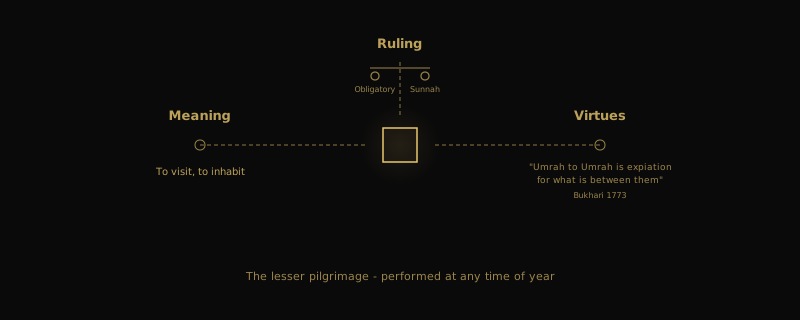
The word Umrah comes from the Arabic root 'a-m-r, which linguistically means to visit or to inhabit a place. In Islamic terminology, Umrah refers to the pilgrimage to the Sacred House of Allah in Makkah, performed at any time of the year, consisting of Ihram, Tawaf around the Ka'bah, Sa'ee between Safa and Marwah, and shaving or trimming the hair. It is often called the "minor pilgrimage" (al-Hajj al-Asghar) to distinguish it from Hajj, the "greater pilgrimage."
The scholars of the four Sunni madhabs have differed on the ruling of Umrah:
Umrah is Wajib (obligatory) once in a lifetime, just as Hajj is obligatory. This is based on the hadith of Aishah (RA) who asked the Prophet (SAW) whether women must make jihad. He replied: "Yes, upon them is a jihad in which there is no fighting: Hajj and Umrah." (Ibn Majah 2901). The conjunction of Umrah with Hajj indicates it shares the same obligatory ruling. They also cite the hadith of Abu Razin al-'Uqayli (RA) who asked the Prophet (SAW) about his father who was old and could not perform Hajj or Umrah. The Prophet said: "Perform Hajj and Umrah on behalf of your father." (Abu Dawud 1810, Tirmidhi 930, Nasai 2621) - the fact that the Prophet ordered it as a substitute indicates obligation.
Umrah is Sunnah Mu'akkadah (an emphasised Sunnah) - highly recommended but not obligatory. Imam Abu Hanifah and Imam Malik held that the Quranic verses and the strongest ahadith about pilgrimage specifically mention Hajj as the obligation, and the evidences for the obligation of Umrah do not reach the level of certainty required to establish a separate obligation. They cite the hadith of Jabir (RA) when the Prophet (SAW) was asked: "Is Umrah obligatory?" He replied: "No, but if you perform it, that is better for you." (Tirmidhi 931) - though this hadith's chain has been discussed by the scholars.
Regardless of the difference, all four madhabs agree that performing Umrah is greatly rewarded and strongly encouraged.
Abu Hurairah (RA) reported that the Prophet (SAW) said: "An Umrah to another Umrah is an expiation for what is between them, and Hajj Mabrur (accepted Hajj) has no reward except Paradise."
- Sahih al-Bukhari 1773, Sahih Muslim 1349Ibn Abbas (RA) reported that the Prophet (SAW) said: "Perform Umrah in Ramadan, for Umrah in Ramadan equals a Hajj" - or he said: "a Hajj with me."
- Sahih al-Bukhari 1782, Sahih Muslim 1256Abdullah ibn Mas'ud (RA) reported that the Prophet (SAW) said: "Alternate between Hajj and Umrah, for they remove poverty and sins just as the bellows removes impurities from iron, gold and silver."
- Sunan an-Nasai 2631, Sunan at-Tirmidhi 810Umrah is called the "minor pilgrimage," but there is nothing minor about standing before the House of Allah. For many Muslims, this first encounter with the Ka'bah is the most overwhelming spiritual experience of their lives. You may have seen it in photographs a thousand times, but nothing can prepare you for the moment the Ka'bah appears before your own eyes. Scholars, warriors, kings and the poorest of the poor - all have wept at this sight. Let your heart be open, for you are about to visit the Lord of all creation at His House.
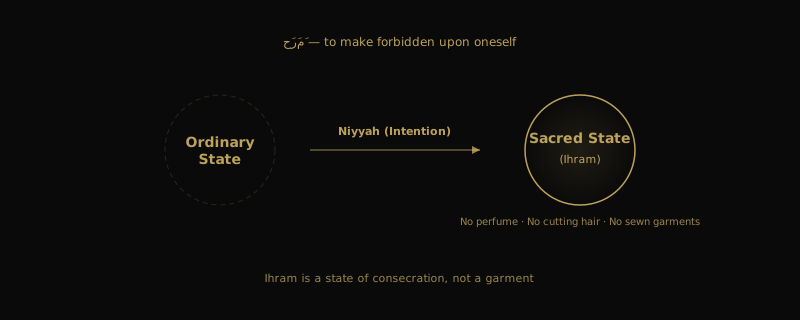
The word Ihram comes from the Arabic root ha-ra-ma, meaning to make something haram (forbidden) upon oneself. When you enter the state of Ihram, you voluntarily forbid upon yourself certain otherwise permissible actions - such as wearing sewn clothing (for men), using perfume, trimming nails, and intimate relations.
One of the most common misconceptions is that Ihram refers to the two white sheets that men wear. This is incorrect. Ihram is the sacred state that a Muslim enters through making an intention (niyyah) to perform Hajj or Umrah. The clothing is merely the physical manifestation and outward symbol of that inner state.
A person who wears the two white sheets but has not made the intention is not in Ihram. Conversely, the moment you make the intention with your heart and tongue, you become a Muhrim (one in the state of Ihram), and all the restrictions apply - regardless of what you happen to be wearing at that exact moment.
Key Point: Ihram = Sacred State entered through intention. The white garments are the dress code of Ihram, not Ihram itself. When you make your niyyah, you become a Muhrim, and all restrictions begin.
Ihram strips you of everything that distinguishes you in the world - your designer clothes, your cologne, your status symbols. Rich and poor, king and commoner, CEO and street sweeper, all wrapped in the same simple white sheets. It is a preview of the kafan (burial shroud) and the Day of Judgement, when no one's wealth or lineage will matter. Every time you feel the rough fabric against your skin, remember: this is how you will be wrapped when you leave this world. Let that thought transform how you walk, how you speak, and how you treat every person around you.
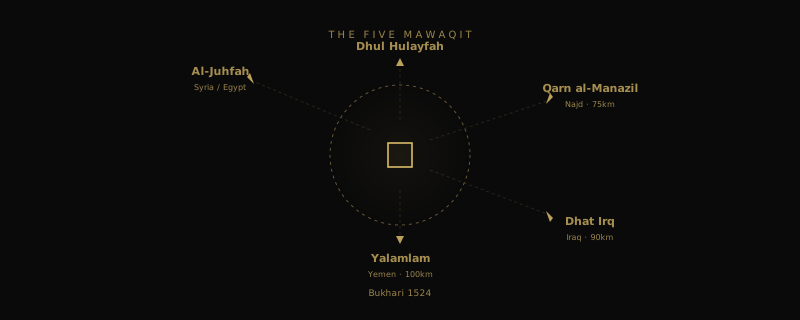
The Mawaqit (singular: Miqat) are the specific geographic boundaries designated by the Prophet (SAW) beyond which no person intending Hajj or Umrah may pass without being in the state of Ihram. These are sacred boundary lines, and crossing them without Ihram - if you intend to perform the pilgrimage - is a violation that requires a penalty.
Ibn Abbas (RA) reported: "The Messenger of Allah (SAW) designated Dhul Hulaifa as the Miqat for the people of Madinah, Al-Juhfah for the people of Sham (Syria), Qarn al-Manazil for the people of Najd, and Yalamlam for the people of Yemen. These are for those who live there and for those who come through them from other lands, intending Hajj or Umrah. And whoever lives within these boundaries should enter Ihram from where he starts his journey, and the people of Makkah should enter Ihram from Makkah."
- Sahih al-Bukhari 1524, Sahih Muslim 1181| Miqat Name | Modern Name | For the People Of | Distance from Makkah |
|---|---|---|---|
| Dhul Hulaifa | Abyar Ali (near Madinah) | Madinah | ~450 km (furthest miqat) |
| Al-Juhfah | Near Rabigh | Sham (Syria, Jordan, Palestine, Lebanon, Egypt, Europe, West Africa, the Americas) | ~183 km |
| Qarn al-Manazil | As-Sayl al-Kabeer | Najd (central Arabia) | ~75 km |
| Yalamlam | As-Sadiyah | Yemen, South/Southeast Asia (by southern route), East Africa | ~100 km |
| Dhat Irq | Al-Dareebah | Iraq, Iran, the East, Central Asia, China | ~90 km |
When travelling by air, the plane passes over or near one of these Mawaqit. You must be in the state of Ihram before the plane crosses the miqat line. This means you should change into your Ihram garments and make your intention either:
Practical Tip: Many airlines (especially Saudi carriers) announce the miqat over the intercom. However, do not rely on this. The safest approach is to enter Ihram at your hotel before heading to the airport. You can wear your Ihram garments with a jacket or thobe over them for comfort, removing them before the miqat. Some pilgrims change into Ihram at the airport before boarding.
Critical Warning: If you arrive at Jeddah airport without having entered Ihram and you intended Umrah or Hajj, you have passed the miqat without Ihram. According to the majority of scholars, this requires a damm (sacrificial penalty - slaughtering a sheep). You should still enter Ihram at Jeddah and proceed, but the penalty stands. Some scholars hold that if you return to the miqat before beginning your rites, the penalty is lifted - but this is difficult and impractical for most travellers.
If you already reside within the miqat boundaries (e.g., in Jeddah, Taif, or any town between the miqat and Makkah), you enter Ihram from wherever you are.
Residents of Makkah have special rules:
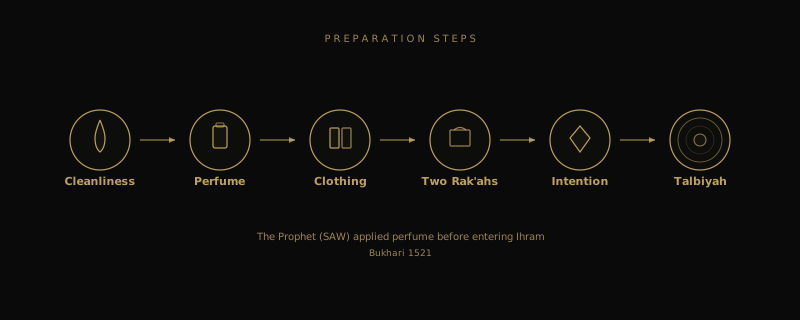
Before entering the state of Ihram, it is Sunnah to prepare yourself physically. These are the recommended preparations:
It is reported that the Prophet (SAW) performed ghusl before entering the state of Ihram.
- Sunan at-Tirmidhi 830If ghusl is not possible (due to lack of water, illness, or travel constraints), then wudu is sufficient.

It is Sunnah to apply perfume or musk to the body before entering the state of Ihram. The perfume should be applied to the body (head, beard, skin), not to the Ihram garments after wearing them.
Aishah (RA) said: "I used to perfume the Messenger of Allah (SAW) for his Ihram before he entered it, and for his coming out of it before he performed Tawaf around the House."
- Sahih al-Bukhari 1539, Sahih Muslim 1189Important: Once you are in the state of Ihram, you may not apply any new perfume. However, the residual scent of perfume applied before entering Ihram is permissible and does not need to be washed off. Aishah (RA) also reported: "I could see the glistening of musk on the scalp of the Prophet (SAW) while he was in Ihram." (Bukhari 1538, Muslim 1190)
Men wear two white, unstitched sheets of cloth:
Additional rules for men's clothing in Ihram:
→ Read the full footwear guide - what each of the four madhabs (Hanafi, Maliki, Shafi'i, Hanbali) say about men's footwear in Ihram, women's footwear, and how to break in your sandals before Hajj.

The Prophet (SAW) said: "Let one of you enter Ihram in an izar, a rida, and sandals."
- Musnad Ahmad 5765Ibn Umar (RA) reported that the Prophet (SAW) said: "The Muhrim should not wear a shirt, a turban, trousers, a hooded cloak, or leather socks, except if he cannot find sandals, in which case he should cut the leather socks below the ankles."
- Sahih al-Bukhari 1542, Sahih Muslim 1177Practical Tip: Practice wearing the Ihram garments at home before you travel. The izar can be tricky to keep secure, especially during Tawaf and Sa'ee when you are moving vigorously. Use safety pins or a specially designed Ihram belt to keep it firmly in place. Many pilgrims have experienced the embarrassment of their izar slipping - preparation prevents this.
The rules for women's Ihram clothing are quite different from men's:

The Prophet (SAW) said: "A woman in Ihram should not wear a niqab or gloves."
- Sahih al-Bukhari 1838If non-mahram men are nearby, a woman may drape a cloth over her face that does not directly touch the skin. This is based on the practice of Aishah (RA), who narrated: "Riders would pass us when we were with the Prophet (SAW) in Ihram. When they came close, each of us would lower her jilbab from her head over her face, and when they passed we would uncover." (Abu Dawud 1833). Many scholars recommend using a cap or visor underneath to hold the cloth away from the face.
It is Sunnah to pray two rak'ahs before making the intention for Ihram. This is based on the general practice of the Prophet (SAW) and his Companions.
If you happen to be at the miqat at the time of an obligatory prayer, you may pray the fard prayer and it will suffice - you do not need an additional two rak'ahs.
This is the most critical step. The intention is what actually puts you in the state of Ihram - not the clothing, not the ghusl, not the prayer. Without the niyyah, you are not in Ihram.
The verbal utterance depends on the type of pilgrimage you are performing:
| Type | What You Say | Meaning |
|---|---|---|
| Umrah only | Labbaika Allahumma Umratan | "Here I am, O Allah, for Umrah" |
| Hajj Tamattu' (Umrah first) | Labbaika Allahumma Umratan | Say Umrah intention now; Hajj intention on 8th Dhul Hijjah |
| Hajj Qiraan | Labbaika Allahumma Hajjan wa Umratan | "Here I am, O Allah, for Hajj and Umrah together" |
| Hajj Ifraad | Labbaika Allahumma Hajjan | "Here I am, O Allah, for Hajj" |
All four madhabs agree that the intention is in the heart. However, the Shafi'i and Hanbali scholars hold that uttering it verbally is Sunnah (recommended), while the Hanafi position is that the verbal utterance is an integral part of the niyyah and is necessary. The Maliki position is similar to the Shafi'i in considering it recommended. In all cases, simply intending in the heart is the minimum requirement.
Conditional Intention (Ishtiraat): If you fear that illness, an emergency, or any obstacle may prevent you from completing your Umrah or Hajj, you may add a condition at the time of your intention: "Allahumma mahilli haithu habastani" (O Allah, my place of release is wherever You prevent me). This is based on the hadith of Duba'ah bint al-Zubayr (RA), who was ill, and the Prophet (SAW) instructed her to make this condition (Sahih al-Bukhari 5089, Sahih Muslim 1207). If you are then prevented, you may exit Ihram without penalty.
Once you enter the state of Ihram, certain actions become prohibited. These restrictions fall into three categories based on their severity.
CRITICAL: Sexual intercourse before the first release from Ihram (i.e., before completing the main rites) invalidates the Hajj entirely. The consequences are severe: the pilgrim must still complete the remaining rites of that Hajj, must repeat the Hajj the following year, and must sacrifice a camel. This is by scholarly consensus (ijma'), based on Quran 2:197: "Whoever undertakes the Hajj therein, then there should be no rafath (sexual relations), no wickedness, and no arguing during Hajj." For Umrah, sexual intercourse similarly invalidates it, requiring it to be repeated with a sacrificial penalty.
The following violations require a fidyah (expiation). The general fidyah for these violations is described in Quran 2:196 as one of three options: fasting three days, feeding six poor persons, or sacrificing a sheep.
| Violation | Details |
|---|---|
| Clipping nails | Cutting or clipping any fingernails or toenails |
| Shaving or cutting hair | Removing hair from any part of the body. Quran 2:196: "And do not shave your heads until the offering reaches the place of sacrifice. Whoever among you is ill or has an ailment of the head, then a ransom of fasting, charity, or sacrifice." |
| Using perfume or scent | Applying any fragrance to the body or clothing after entering Ihram, including scented soap, shampoo, or deodorant |
| Wearing sewn/stitched clothing (men) | Shirts, trousers, underwear, socks, gloves, or any tailored garment that is sewn to the shape of the body |
| Covering the head (men) | Any head covering that directly sits on the head: cap, turban, hat, hoodie, towel wrapped on head |
| Wearing niqab or gloves (women) | A face veil whose fabric touches the face, or gloves |
| Marriage contract | A Muhrim may not marry, arrange a marriage for others, or propose marriage |
| Hunting land game | Killing or hunting any land animal. Quran 5:95: "O you who believe! Do not kill game while you are in Ihram." The penalty is the equivalent value of the animal killed. |
Uthman ibn Affan (RA) reported that the Prophet (SAW) said: "A Muhrim should not marry, nor give in marriage, nor propose."
- Sahih Muslim 1409These actions are sinful at all times but are especially emphasised during Ihram:
"Hajj is [in] well-known months. Whoever undertakes Hajj therein, then there should be no obscenity (rafath), no wickedness (fusuq), and no arguing (jidal) during Hajj."
- Quran 2:197The following are permissible while in the state of Ihram:
Ibn Abbas (RA) said: "There is no harm if a Muhrim wears a ring or a belt pocket."
- al-BayhaqiAccidental Violations: If you accidentally apply perfume, remove it immediately with water. If you accidentally cover your head (men), remove the covering immediately. Most scholars hold that there is no penalty for accidental violations that are corrected immediately. The penalty applies when the violation is done deliberately or when the person continues the violation after realising it.
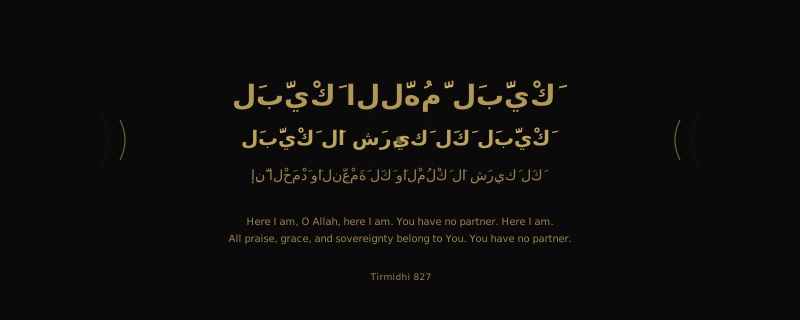
The Talbiyah is the proclamation of tawheed - the declaration of Allah's Oneness - that the pilgrim recites continuously from the moment of entering Ihram. It is one of the most powerful and moving aspects of the pilgrimage.
لَبَّيْكَ اللَّهُمَّ لَبَّيْكَ، لَبَّيْكَ لَا شَرِيكَ لَكَ لَبَّيْكَ، إِنَّ الْحَمْدَ وَالنِّعْمَةَ لَكَ وَالْمُلْكَ، لَا شَرِيكَ لَكَ
Labbaika Allahumma Labbaik. Labbaika la shareeka laka Labbaik. Innal-hamda wan-ni'mata laka wal-mulk. La shareeka lak.
"Here I am at Your service, O Allah, here I am. Here I am, You have no partner, here I am. Verily all praise, all grace, and all sovereignty belong to You. You have no partner."
Zaid ibn Khalid (RA) reported that the Prophet (SAW) said: "Gabriel came to me and told me: 'Command your Companions to raise their voices when saying Talbiyah, for it is among the symbols of Hajj.'"
- Sunan Ibn Majah 2922, Musnad AhmadMen should recite the Talbiyah loudly and with conviction.
Women should recite it audibly enough that they and those immediately around them can hear, but not loudly.
The Prophet (SAW) said: "Whoever makes talbiyah until the sun sets, the sun will set and he will be free of his sins as the day his mother gave birth to him."
- Sunan at-TirmidhiSahl ibn Sa'd (RA) reported that the Prophet (SAW) said: "There is no Muslim who recites the Talbiyah except that every stone, tree, and pebble on his right and his left also recites the Talbiyah, and this continues until the earth resounds with it from all sides."
- Sunan Ibn Majah, Sunan at-Tirmidhi 828Some Companions added to the Talbiyah, such as "Labbaika dha'l-ma'arij, Labbaika dha'l-fawaadil" (Here I am, O Lord of the ascending ways, here I am, O Lord of bounties). The Prophet (SAW) heard them and did not object. However, the words of the Prophet (SAW) are the best and most complete, and sticking to them is preferable.
"Labbaik" means "Here I am, at Your service" - repeatedly, emphatically, unconditionally. It is the response to Ibrahim's (AS) call thousands of years ago, when Allah commanded him: "And proclaim to the people the Hajj; they will come to you on foot and on every lean camel; they will come from every distant pass" (Quran 22:27). When you say "Labbaik," you are answering that ancient invitation. You are declaring: I have no partner in worship, everything I have is from You, all praise belongs to You. The Talbiyah is the anthem of tawheed, the battle cry against every idol of the heart - money, status, ego, desire. Let each repetition strip another layer away until nothing remains but you and your Lord.
Umrah consists of the following steps, performed in order. Each step is explained in full detail in the sections that follow.
The pillars (arkan) of Umrah according to the majority of scholars are: Ihram, Tawaf, and Sa'ee. Without any one of these, the Umrah is not valid. Shaving/trimming the hair is either a pillar (Shafi'i) or an obligation (Hanafi, Hanbali) whose omission requires a penalty but does not invalidate the Umrah.
As you approach the greatest mosque on earth, approach with humility, awe, and anticipation. Enter with your right foot first, as is the Sunnah for entering any mosque.
بِسْمِ اللَّهِ وَالصَّلَاةُ وَالسَّلَامُ عَلَى رَسُولِ اللَّهِ، اللَّهُمَّ اغْفِرْ لِي ذُنُوبِي وَافْتَحْ لِي أَبْوَابَ رَحْمَتِكَ. أَعُوذُ بِاللَّهِ الْعَظِيمِ وَبِوَجْهِهِ الْكَرِيمِ وَبِسُلْطَانِهِ الْقَدِيمِ مِنَ الشَّيْطَانِ الرَّجِيمِ
Bismillah, was-salaatu was-salaamu 'ala Rasoolillah. Allahumma-ghfir li dhunoobi waftah li abwaaba rahmatik. A'oodhu Billahil-'Adheem, wa bi wajhihil-kareem, wa bi sultaanihil-qadeem, minash-shaytaanir-rajeem.
"In the name of Allah, and peace and blessings be upon the Messenger of Allah. O Allah, forgive my sins and open for me the doors of Your mercy. I seek refuge in Allah the Almighty, and in His noble Face, and in His eternal Power, from the accursed Shaytan."
- Based on Sahih Muslim 713, Abu Dawud 466
When you first lay eyes on the Ka'bah, this is a moment when dua is accepted. Scholars including Ibn al-Qayyim (rahimahullah) have mentioned this, and it is reported from some of the Companions and Tabi'een. Though the specific narration has been discussed by hadith scholars, the principle of making dua at moments of spiritual impact is well-established.
Practical Tip: Prepare your most important duas before arriving. Write them down if needed. When you first see the Ka'bah, do not rush to start Tawaf. Take a moment. Let the sight settle into your heart. Raise your hands and pour out your most heartfelt supplications. Many pilgrims later regret that they were so overwhelmed they forgot to make dua at this moment.
There are no words that can prepare you for the first time you see the Ka'bah. Many pilgrims weep uncontrollably. Hardened men cry like children. Scholars who have read about it for decades find themselves speechless. This is the House that Ibrahim (AS) built, stone by stone, with his son Ismail. This is the direction that Muhammad (SAW) prayed towards for 23 years. This is the point around which billions of hearts have orbited for millennia. You are standing where angels stood before humanity existed. Let yourself feel it fully. There is no shame in tears before the House of Allah.
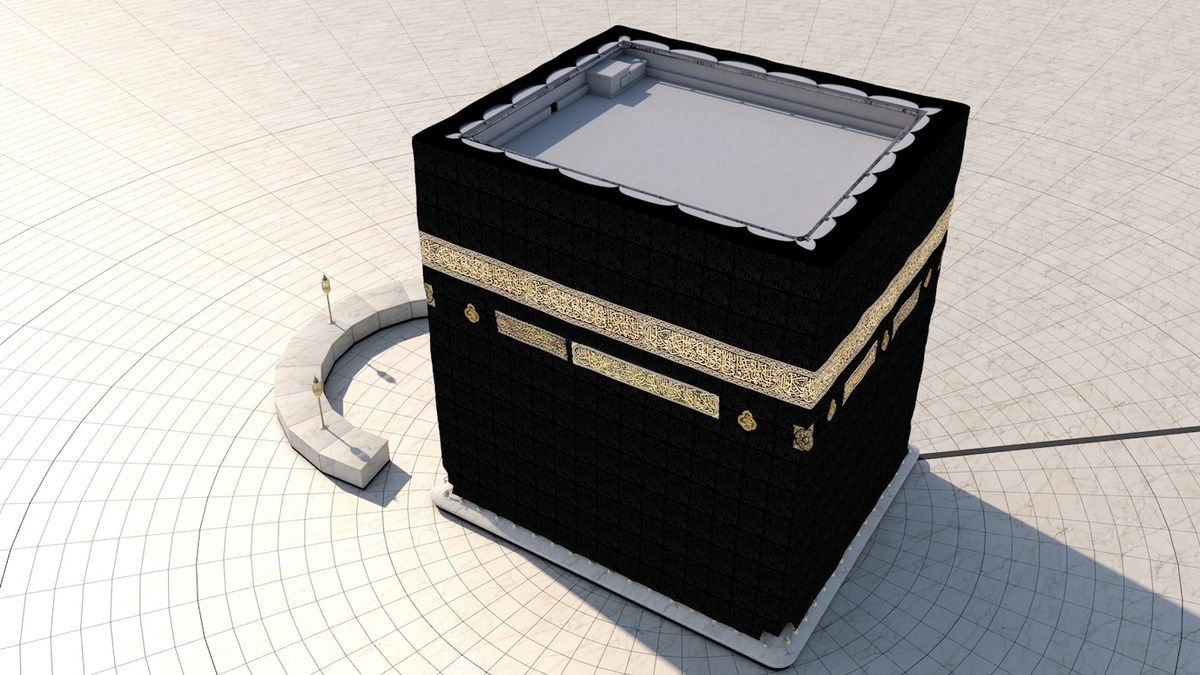
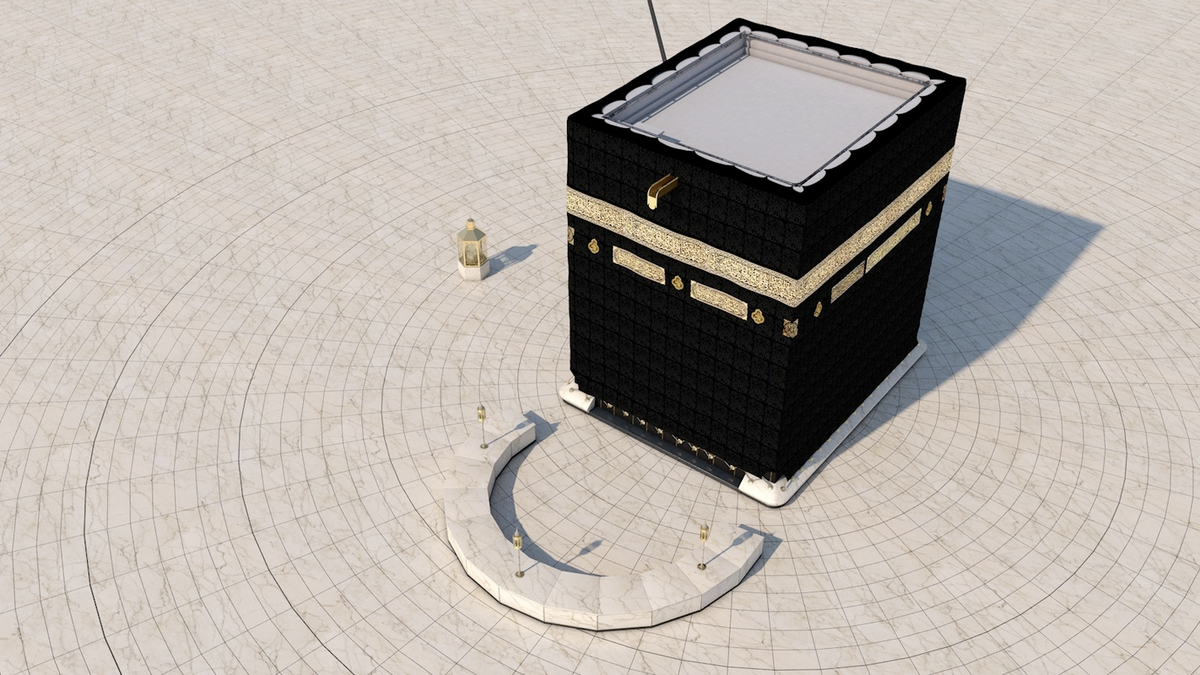
The Ka'bah stands at the centre of Masjid al-Haram in Makkah, the first House of worship established for mankind on earth.
"Indeed, the first House [of worship] established for mankind was that at Bakkah (Makkah) - blessed and a guidance for the worlds. In it are clear signs, the standing place of Ibrahim. And whoever enters it shall be safe."
- Quran 3:96-97The Ka'bah has four corners, each named after the region it faces:
| Corner | Arabic Name | Significance |
|---|---|---|
| The Black Stone Corner | Ar-Rukn al-Aswad (al-Hajar al-Aswad) | The eastern corner; where Tawaf begins and ends. Contains the Black Stone. |
| The Iraqi Corner | Ar-Rukn al-Iraqi | The northern corner, facing Iraq |
| The Levantine Corner | Ar-Rukn ash-Shami | The western corner, facing the Levant (Sham/Syria) |
| The Yemeni Corner | Ar-Rukn al-Yamani | The southern corner, facing Yemen. It is Sunnah to touch this corner during Tawaf. |
The Black Stone is set into the eastern corner of the Ka'bah, approximately 1.5 metres above the ground. It is the starting and ending point of each circuit of Tawaf.
Ibn Abbas (RA) reported that the Prophet (SAW) said: "The Black Stone came down from Paradise whiter than milk, but the sins of the sons of Adam turned it black."
- Sunan at-Tirmidhi 877, Musnad AhmadUmar ibn al-Khattab (RA) came to the Black Stone, kissed it, and said: "I know that you are a stone and can neither benefit nor harm. Had I not seen the Prophet (SAW) kissing you, I would not have kissed you."
- Sahih al-Bukhari 1597, Sahih Muslim 1270Umar's statement is a profound lesson in tawheed. We do not worship the stone. We do not believe it has divine power. We kiss it or point towards it as an act of obedience to Allah and His Messenger, nothing more.
The Hateem (also called Hijr Ismail) is the semi-circular walled area on the northern side of the Ka'bah. A portion of it is actually part of the Ka'bah - the original Ka'bah built by Ibrahim (AS) included this area, but when the Quraysh rebuilt the Ka'bah before Islam, they did not have enough lawful funds to include all of it.
Aishah (RA) narrated that the Prophet (SAW) said: "Did you not see that when your people rebuilt the Ka'bah, they fell short of the foundations of Ibrahim?" I said: "O Messenger of Allah, will you not return it to the foundations of Ibrahim?" He said: "Were it not that your people are still close to the pre-Islamic period, I would have done so." He also indicated that approximately six cubits of the Hijr is part of the Ka'bah.
- Sahih al-Bukhari 1584, Sahih Muslim 1333Key Point: If you pray inside the Hateem, you are essentially praying inside the Ka'bah. This is one of the most blessed places on earth to pray. When it is not too crowded, try to offer voluntary prayers inside the Hateem.
The Multazam is the area of the Ka'bah wall between the Black Stone and the door of the Ka'bah. It is a place where dua is accepted. The Companions would press their chests, faces, forearms, and palms against this part of the wall and make dua.
Abdullah ibn Amr (RA) used to press his chest, face, and hands against the Multazam and make dua.
- Abu Dawud 1899The Ka'bah has a heavenly counterpart. In the hadith of al-Isra (the Night Journey), the Prophet (SAW) described that upon ascending to the seventh heaven, he was shown Al-Bayt al-Ma'mur - the Frequented House - directly above the Ka'bah. Seventy thousand angels pray there daily and never return, replaced by another group the following day, for eternity.
The Prophet (SAW) said during the narration of al-Isra: "Then I was taken up to al-Bayt al-Ma'mur. I asked Gabriel and he said: 'This is al-Bayt al-Ma'mur. Seventy thousand angels pray in it every day and when they leave, they never return.'"
- Sahih al-Bukhari 3207, Sahih Muslim 162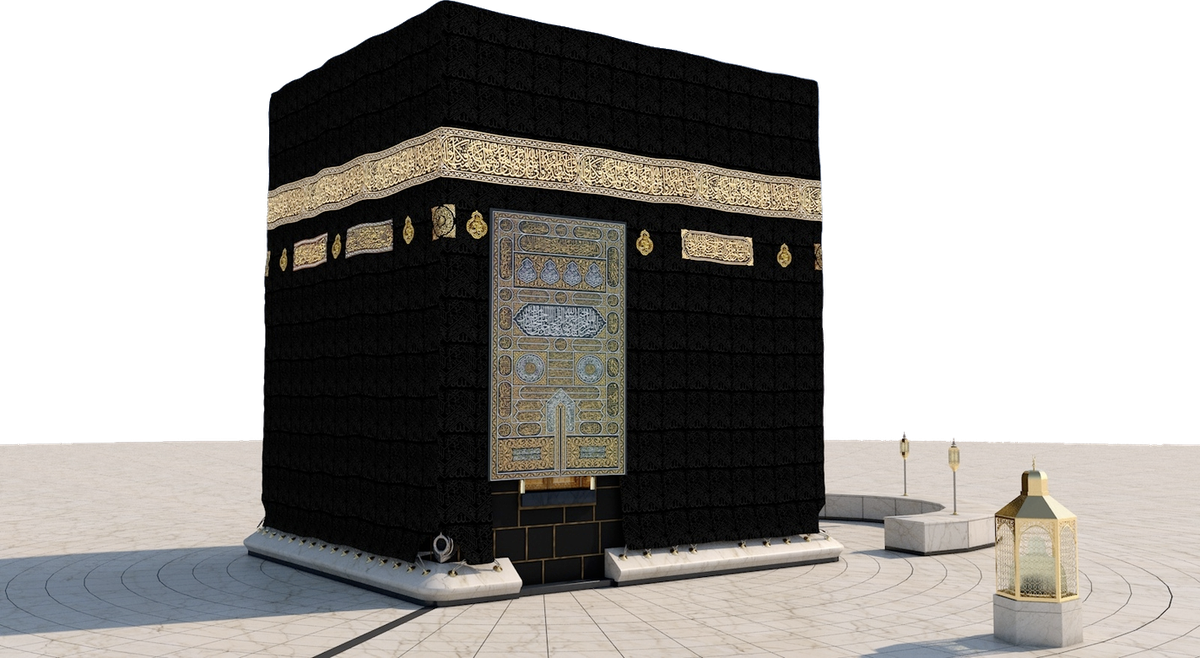
Tawaf is the act of circumambulating (walking around) the Ka'bah seven times in an anti-clockwise direction, with the Ka'bah on your left. Each complete circuit starts and ends at the Black Stone.
Ibn Abbas (RA) said: "Tawaf around the House is like prayer, except that you can speak during it. So whoever speaks during it, let him not speak except good."
- Sunan at-Tirmidhi 960, Sunan an-NasaiAt the Black Stone, perform one of the following (in order of preference):
Ibn Abbas (RA) reported that the Prophet (SAW) performed Tawaf on his camel, and every time he came to the corner (of the Black Stone), he pointed to it with something in his hand and said "Allahu Akbar."
- Sahih al-Bukhari 1611Then say: "Bismillah, Allahu Akbar" and begin walking counter-clockwise.
Important: There are NO specific, prescribed duas for each individual circuit of Tawaf. Despite what some printed dua booklets suggest, the Prophet (SAW) did not designate specific supplications for the 1st circuit, 2nd circuit, etc. Those booklets contain general duas compiled by later scholars as suggestions, not Sunnah. You may use them if you find them helpful, but do not believe they are obligatory or specifically prescribed.
During Tawaf, you may:
In the first three circuits only, men should perform Raml: walking briskly with short, quick steps, chest puffed out, shoulders moving. This is for men only, and only during Tawaf of arrival/Umrah - not in every Tawaf.
Ibn Umar (RA) reported that the Prophet (SAW) walked rapidly (raml) in the first three circuits and walked at a normal pace in the remaining four.
- Sahih Muslim 1261In circuits 4 through 7, walk at a normal, relaxed pace.
When you reach the Yemeni Corner (the corner just before the Black Stone corner):
This short stretch between the Yemeni Corner and the Black Stone is the one place in Tawaf where there is a specific Sunnah dua:
رَبَّنَا آتِنَا فِي الدُّنْيَا حَسَنَةً وَفِي الْآخِرَةِ حَسَنَةً وَقِنَا عَذَابَ النَّارِ
Rabbana aatina fid-dunya hasanatan wa fil-aakhirati hasanatan wa qina 'adhab an-nar.
"Our Lord, give us good in this world and good in the Hereafter, and protect us from the punishment of the Fire."
- Abu Dawud 1892
Each time you pass the Black Stone (completing one circuit), repeat the action: kiss it, touch it, or point towards it and say "Allahu Akbar."
What if I lose count of my circuits?
Take the lower number you are certain of and continue from there. This is based on the principle of certainty (al-yaqeen la yazul bi'sh-shakk) - certainty is not overridden by doubt. If you are unsure whether you completed 5 or 6, consider it 5 and continue.
What if I break wudu during Tawaf?
Go and renew your wudu, then return and continue from where you stopped. You do not need to restart the entire Tawaf from the beginning.
What if the prayer (salah) starts during my Tawaf?
Stop your Tawaf, join the congregational prayer where you are standing, and after the prayer, continue your Tawaf from where you paused.
What if I am pushed away from my path?
Continue from approximately where you were. Tawaf does not require precision to the centimetre. Return to the general area and continue your circuit.
Can I talk during Tawaf?
Yes, speech is permitted (unlike prayer). However, it is far better to focus on dhikr, dua, and Quran recitation. Avoid idle chat.
Can women perform Tawaf during menstruation?
No. Since Tawaf requires wudu (ritual purity), a woman experiencing menstruation must wait until her period ends, perform ghusl, and then do Tawaf. She may perform all other rites of Hajj and Umrah (Sa'ee, staying at Arafat, etc.) during menstruation - but not Tawaf.
The Prophet (SAW) said to Aishah (RA) when she got her period: "Do everything the pilgrim does, except do not perform Tawaf around the House until you are clean."
- Sahih al-Bukhari 1650Do NOT push or shove to reach the Black Stone. The Prophet (SAW) said to Umar (RA): "O Umar, you are a strong man. Do not crowd others at the Black Stone, for you will harm the weak. If you find an opening, go for it. Otherwise, face it and say 'Allahu Akbar.'" (Musnad Ahmad). Pointing from a distance is a complete Sunnah - you lose nothing by not touching or kissing the stone. But you will be sinful if you harm another Muslim in the attempt.
After completing all seven circuits of Tawaf, proceed to Maqam Ibrahim (the Station of Ibrahim) and pray two rak'ahs behind it. This is a command from the Quran itself.
"And take from the standing place of Ibrahim a place of prayer."
- Quran 2:125Practical Tip: Men should cover both shoulders before praying. The Idtiba' (exposing the right shoulder) was for Tawaf only, not for prayer. Praying with the right shoulder exposed means praying without properly covering the 'awrah, which some scholars consider problematic.
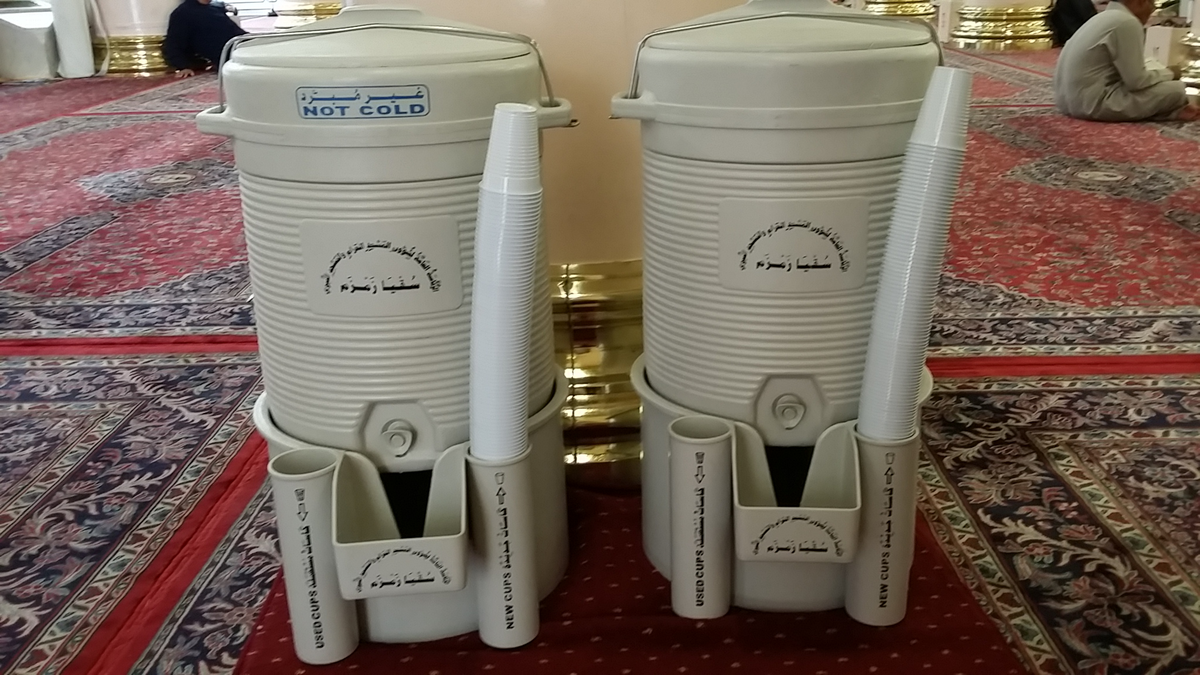
After completing the two rak'ahs behind Maqam Ibrahim, it is Sunnah to drink Zamzam water. Zamzam is the miraculous water that sprang forth when the infant Ismail (AS) kicked the ground (or when the angel Jibreel struck it), saving him and his mother Hajra from dying of thirst in the barren desert of Makkah.
The Prophet (SAW) said: "The water of Zamzam is for whatever purpose it is drunk for."
- Sunan Ibn Majah 3062The Prophet (SAW) said: "The best water on the face of the earth is the water of Zamzam. In it is food for the hungry and a cure for the sick."
- Sahih Muslim 2473 (partial), at-TabaraniIt is also narrated that the Prophet (SAW) drank Zamzam while standing (Bukhari 1637), though drinking while sitting is the general Sunnah for other beverages. Scholars have reconciled this by saying both are permissible for Zamzam.
Practical Tip: Make your most important dua while drinking Zamzam. Many scholars, including Imam Ibn al-Qayyim, recommended asking for beneficial knowledge, vast provision, and cure from every disease when drinking Zamzam. Whatever you sincerely ask for, trust in the promise of the Prophet (SAW).
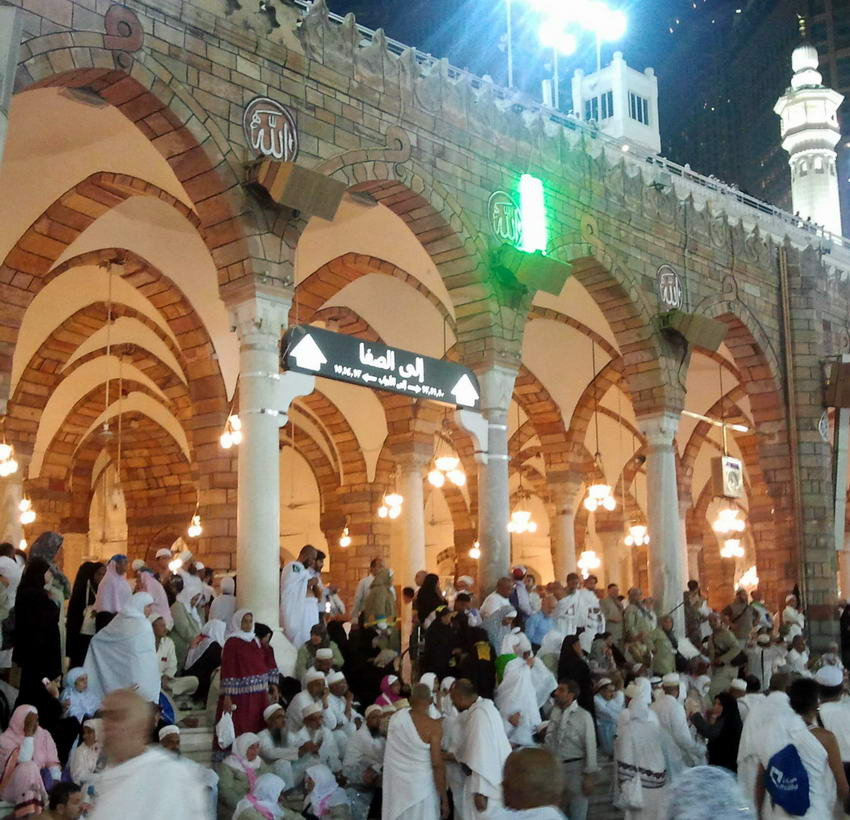
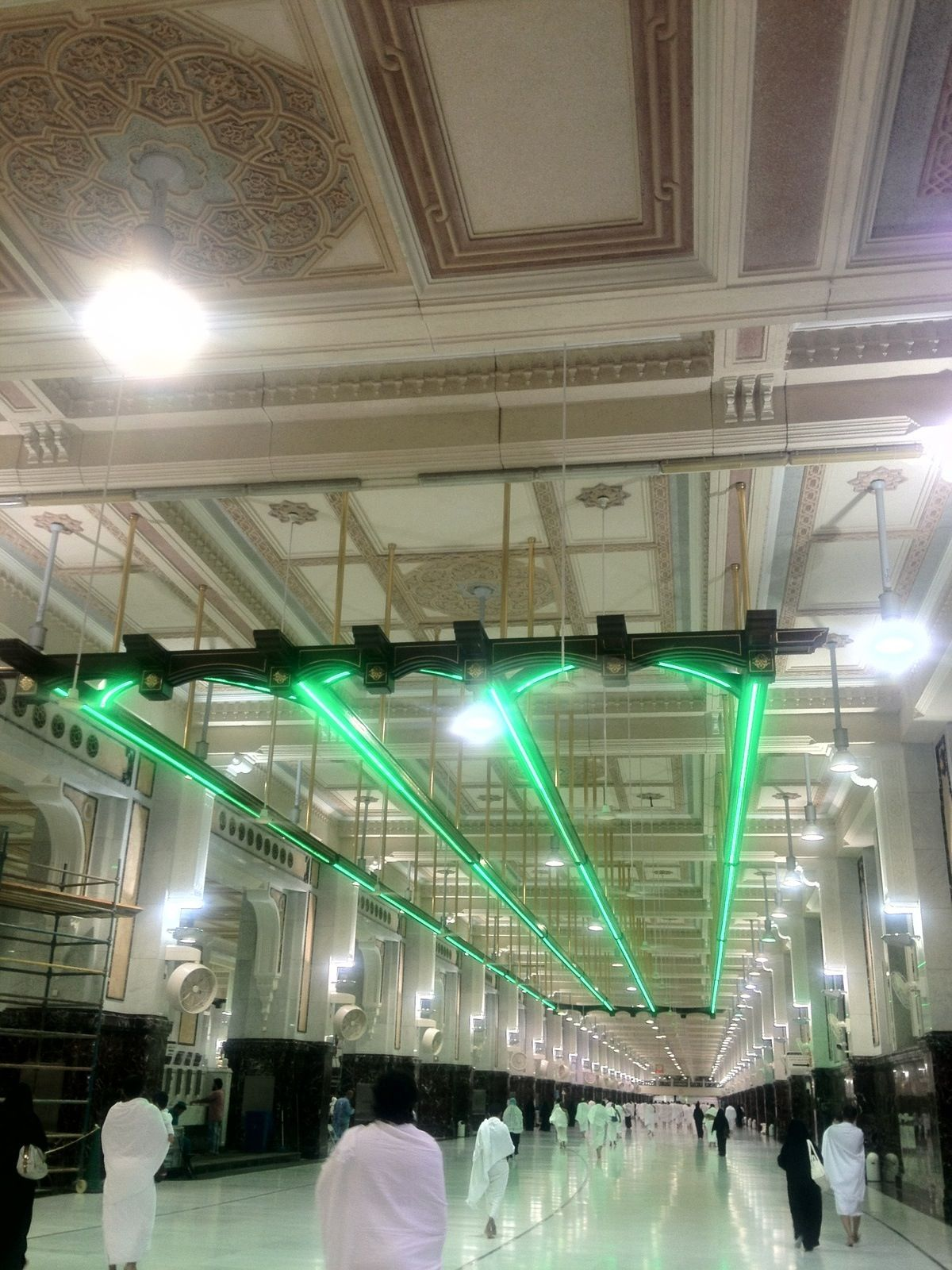
Sa'ee is the act of walking back and forth between the hills of Safa and Marwah seven times, commemorating Hajra's (Hagar's) desperate search for water for her son Ismail (AS). The Sa'ee takes place in al-Mas'a, the enclosed, air-conditioned corridor between the two hills within Masjid al-Haram.
"Indeed, Safa and Marwah are among the symbols of Allah. So whoever makes Hajj to the House or performs Umrah - there is no blame upon him for walking between them. And whoever volunteers good - then indeed, Allah is Appreciative and Knowing."
- Quran 2:158After drinking Zamzam, head towards Safa. When you are near Safa, recite the above verse (Quran 2:158) and then say:
نَبْدَأُ بِمَا بَدَأَ اللَّهُ بِهِ
Nabda'u bima bada'Allahu bihi
"We begin with that which Allah began with."
This is based on the hadith of Jabir (RA) describing the Prophet's Hajj: "He (SAW) began with Safa, and said: 'We begin with that which Allah began with.'"
- Sahih Muslim 1218Note: This verse and this statement are recited only once upon approaching Safa for the first time, not at the beginning of every circuit.
لَا إِلَهَ إِلَّا اللَّهُ وَحْدَهُ لَا شَرِيكَ لَهُ، لَهُ الْمُلْكُ وَلَهُ الْحَمْدُ وَهُوَ عَلَى كُلِّ شَيْءٍ قَدِيرٌ، لَا إِلَهَ إِلَّا اللَّهُ وَحْدَهُ، أَنْجَزَ وَعْدَهُ، وَنَصَرَ عَبْدَهُ، وَهَزَمَ الْأَحْزَابَ وَحْدَهُ
La ilaha illAllahu wahdahu la shareeka lah, lahul-mulk wa lahul-hamd wa huwa 'ala kulli shay'in qadeer. La ilaha illAllahu wahdah, anjaza wa'dah, wa nasara 'abdah, wa hazama al-ahzaba wahdah.
"There is no god but Allah alone, with no partner. To Him belongs sovereignty and to Him belongs all praise, and He has power over all things. There is no god but Allah alone. He fulfilled His promise, supported His servant, and defeated the confederates alone."
- Sahih Muslim 1218
Repeat this dhikr three times, making your own personal dua between each repetition. Supplicate for whatever is in your heart - this is a blessed station where dua is accepted.
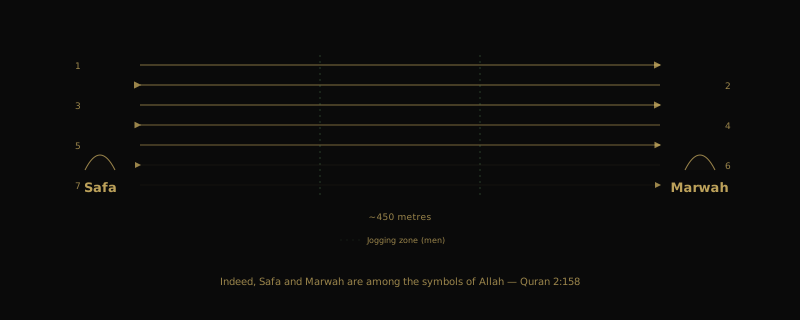
Begin walking from Safa towards Marwah. Safa to Marwah = 1 circuit.
Along the path, you will see two sets of green fluorescent lights/markers on the walls and pillars. Between these markers lies the valley where Hajra (AS) ran when she could no longer see her son from the valley floor.
When you reach Marwah, climb it, face the Ka'bah, raise your hands, and repeat the same dhikr and dua you made on Safa (La ilaha illAllahu wahdahu..., three times, with personal dua in between).
| Circuit | From | To |
|---|---|---|
| 1 | Safa | Marwah |
| 2 | Marwah | Safa |
| 3 | Safa | Marwah |
| 4 | Marwah | Safa |
| 5 | Safa | Marwah |
| 6 | Marwah | Safa |
| 7 | Safa | Marwah (END) |
Key Rule: You always start on Safa and end on Marwah. Seven circuits means you finish on Marwah. If you end on Safa, you have only completed six circuits (an even number always ends back where it started).
If you lose count of your circuits, take the lower number you are certain of and continue from there.
Unlike Tawaf, wudu is not a requirement for Sa'ee according to the majority of scholars. If you break your wudu during Sa'ee, you may continue without renewing it. However, being in a state of wudu is always preferable and more virtuous.
Practical Tips for Sa'ee:
Every step of Sa'ee is a step in Hajra's footsteps. Picture her - a mother, alone in a barren desert, her infant crying from thirst, no help in sight, no phone to call, no one to turn to except Allah. She did not sit and despair. She ran. Between two rocky hills, again and again, seven times, searching frantically for any sign of water or any passing caravan. Allah did not just save her child - He made her desperate run an eternal act of worship that billions would repeat until the Day of Judgement. He made water gush from the earth beneath her baby's feet, a spring that still flows today. Never underestimate what Allah can make of your struggle. Your hardest moments, your most desperate prayers, the times you feel most alone - these may be the very moments that define your eternity.
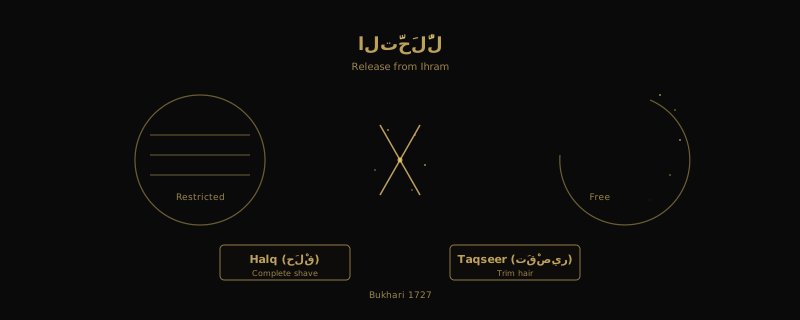
After completing the seven circuits of Sa'ee, the final act of Umrah is to shave or trim the hair. This is the act that releases you from the state of Ihram.
Both are valid, but shaving the entire head is superior for men. The Prophet (SAW) made dua for those who shaved three times, and for those who trimmed only once.
Ibn Umar (RA) reported that the Prophet (SAW) said: "O Allah, have mercy on those who shave their heads." The people said: "And those who trim their hair, O Messenger of Allah?" He (SAW) said: "O Allah, have mercy on those who shave their heads." They said again: "And those who trim their hair, O Messenger of Allah?" He (SAW) said: "O Allah, have mercy on those who shave their heads." They said: "And those who trim their hair, O Messenger of Allah?" He (SAW) then said: "And those who trim their hair."
- Sahih al-Bukhari 1727, Sahih Muslim 1301Your Umrah is now complete! Alhamdulillah!
After cutting your hair, you are released from ALL restrictions of Ihram. Everything that was forbidden - sewn clothing, perfume, covering the head, intimacy - is now permissible again. You may change into your regular clothes, apply perfume, and resume all normal activities. May Allah accept your Umrah!
Practical Tip: Barbers near the Haram are very experienced and fast. The price is usually very reasonable. If you prefer privacy, you can return to your hotel. For women, it is often more practical to trim their hair at the hotel. Some women bring a small pair of scissors specifically for this purpose.
Be aware of these frequently made errors so you can avoid them:
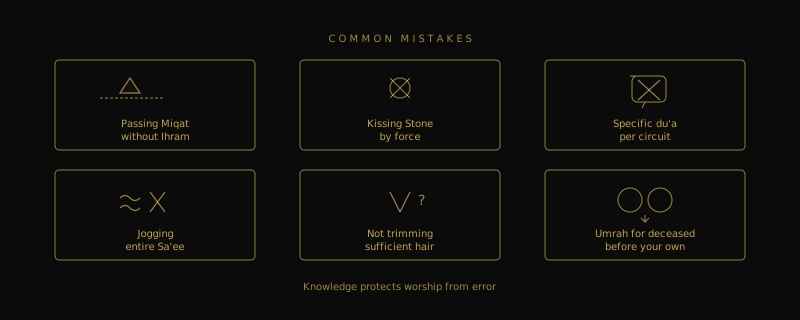
1. Passing the Miqat without Ihram: Some travellers, especially first-timers flying to Jeddah, fail to enter Ihram before passing the miqat boundary. This requires a damm (sacrifice) as penalty. Always prepare before you fly.
2. Reciting specific duas for each Tawaf circuit: Many dua booklets assign specific long supplications to each circuit (1st circuit dua, 2nd circuit dua, etc.). This has no basis in the Sunnah. The Prophet (SAW) never prescribed circuit-specific duas. Use these booklets as suggestions for general dua if you wish, but do not believe they are obligatory. The best dua is what comes from your own heart.
3. Pushing and shoving at the Black Stone: This causes harm to other Muslims and is sinful. Pointing from a distance is a complete and valid Sunnah. You gain nothing extra by touching the stone if you harm others in the process.
4. Praying the 2 rak'ahs facing the Maqam Ibrahim enclosure instead of behind it: The instruction is to pray with the Maqam between you and the Ka'bah - i.e., facing the Ka'bah with the Maqam in front of you. Some people mistakenly face the Maqam with their backs to the Ka'bah.
5. Starting Sa'ee from Marwah instead of Safa: Sa'ee must begin at Safa. If you accidentally start from Marwah, that first walk does not count as a circuit - start counting from when you reach Safa.
6. Not running between the green markers (men): The brisk walk/jog between the two green markers is a Sunnah that many men neglect. It commemorates Hajra's running and should not be skipped without reason.
7. Trimming only a few hairs instead of the entire head: Some men trim just a small patch or a few strands and consider it sufficient. The correct practice is to trim from the entire head - all sides. Simply cutting two or three hairs does not fulfil the requirement.
8. Continuing Idtiba' (exposed right shoulder) during prayer: Idtiba' is only for Tawaf. Before praying the two rak'ahs behind Maqam Ibrahim, men must cover both shoulders properly.
9. Making Tawaf outside the Hateem: If you walk through the Hateem during Tawaf, that circuit does not count, because the Hateem is part of the Ka'bah. Your Tawaf must go around the Hateem, not through it.
10. Supplicating only in Arabic when you do not understand it: While Arabic duas from the Quran and Sunnah are best, there is nothing wrong with making dua in your own language during Tawaf and Sa'ee. A heartfelt dua you understand is far better than reciting Arabic words without comprehension. Use both - memorised Arabic duas and personal supplications in your language.
Do you know all the steps of Umrah? Test yourself before you go.
Take the Umrah Essentials Quiz →Saudi Arabia's official Nusuk app has added spiritual, navigation and health tools plus a zero-data offline mode, and no...
The Saudi Ministry of Hajj and Umrah has received the national AI ethics badge from SDAIA for its Nusuk AI service, as i...
Saudi Arabia's Ministry of Hajj and Umrah now requires a verified medical fitness certificate, processed through the Nus...
Nigeria's National Hajj Commission has fixed 2027 Hajj fares between N7.56 million and N7.88 million and reaffirmed 26 S...