Women’s Guide to Hajj & Umrah
Women have been performing Hajj since the time of the Prophet (peace be upon him), and Aishah (may Allah be pleased with her) is one of our greatest sources of knowledge about the pilgrimage. This guide covers the practical considerations specific to women.
Women’s Ihram Clothing
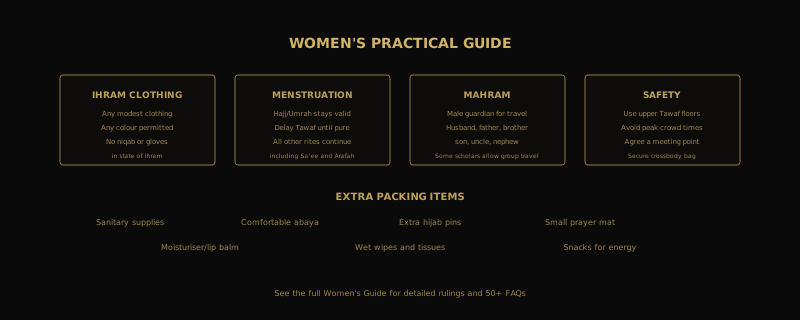
Unlike men, women do not have a specific uniform for ihram. A woman’s ihram is simply any modest clothing that covers the body, with two specific restrictions:
- No niqab (face veil): The face should be uncovered during ihram according to the majority of scholars. However, if non-mahram men are nearby, a woman may drape a cloth from her head over her face (without it being a fitted niqab).
- No gloves: The hands should be uncovered while in ihram, similar to the face ruling.
- Clothing can be any colour - it does not need to be white. Many women wear white for simplicity, but this is not required.
- Wear comfortable, loose-fitting clothing in lightweight, breathable fabric. A simple abaya with a loose hijab works well.
Tip: Bring at least 2-3 sets of ihram clothing. You may need to change due to sweating, washing for ihram renewal, or practical needs. Pack lightweight, quick-dry fabrics.
Menstruation During Hajj & Umrah
This is one of the most common concerns for women. The key rulings are:
- A menstruating woman can do everything in Hajj except Tawaf. She can stand at Arafat, stay in Muzdalifah, pelt the Jamarat, and make du’a. She should not perform Tawaf or pray Salah until she is pure.
- For Umrah: If your period starts before completing Umrah, you wait until it ends, perform ghusl, and then complete your Tawaf and Sa’i.
- Tawaf al-Ifadah (Hajj): This is a pillar of Hajj and cannot be skipped. If your period begins before you can do it, you must wait until you are pure. There is scholarly discussion about performing it in a state of necessity if you cannot delay your departure - consult a scholar in this situation.
- Tawaf al-Wada’ (farewell Tawaf): A menstruating woman is exempted from the farewell Tawaf. This is based on the hadith of Safiyyah (may Allah be pleased with her).
Practical advice: Some women consult their doctor about taking medication to delay their period during Hajj. This is permissible according to most scholars if done safely under medical guidance. Discuss this with your doctor well in advance of travel.
Mahram Requirements
Traditionally, a woman needs a mahram (male guardian: husband, father, son, brother, etc.) to travel for Hajj. However:
- Saudi Arabia has relaxed this requirement in recent years. Women aged 45 and above may now perform Hajj without a mahram if travelling in an organised group.
- For Umrah and tourist visas, there is generally no mahram requirement for women travelling alone, regardless of age.
- Rules can vary by your country of origin and the specific Hajj ministry regulations for that year. Check with your tour operator.
Women’s Sections in the Mosques
Both Masjid al-Haram and the Prophet’s Mosque have designated women’s prayer areas, though women can pray in most areas of the mosque. In Masjid al-Haram, women perform Tawaf alongside men on the same floors (there is no separate Tawaf area). For Sa’i, women walk the same path as men.
Safety Tips for Women
- Saudi Arabia is generally very safe for women travellers, especially in and around the holy sites.
- Stay close to your group, particularly in very crowded situations.
- Keep valuables in a concealed money belt worn under your clothing.
- If you feel unwell or unsafe, approach any of the female security personnel or volunteers stationed throughout the Haram.
Extra Packing Items for Women
- Extra hijabs and prayer clothes (lightweight, quick-dry)
- Sanitary products (available in Saudi but bring your preferred brand)
- Hair ties and pins (for securing hijab during Tawaf in windy/crowded conditions)
- Compact mirror
- Moisturiser and lip balm (the dry heat is harsh on skin)
- Comfortable sports bra for long walks